Introduction
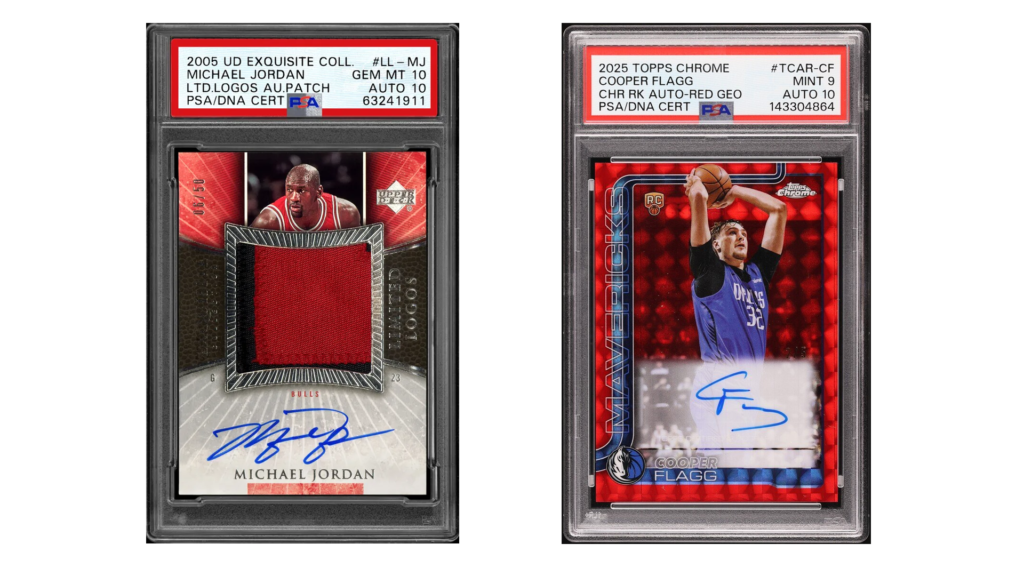
Here’s a question I genuinely didn’t expect to be asking myself in 2025: should I put my next few hundred dollars into a Michael Jordan auto or a Cooper Flagg rookie auto? And yet, here we are. In 2025, a Michael Jordan and Kobe Bryant dual autographed patch card sold for $12.93 million — officially the most expensive sports card ever sold at public auction. Meanwhile, across town in the hobby’s collective attention, a 19-year-old forward from Duke is pulling in thousands of dollars per card before he’s even finished his first NBA season. The contrast is wild, and honestly, it’s what makes the hobby so fun right now.
So is it better to invest in a Michael Jordan auto or a Cooper Flagg auto? The truth is, there’s no single answer — but there are some really clear principles that should guide your decision depending on how much you want to spend, how long you’re willing to hold, and how much risk you’re comfortable with. Whether you’re a seasoned collector looking to diversify or a newer hobbyist wondering where to put your first real card investment dollars, this guide breaks down both sides of this debate in honest, practical detail. Let’s get into it!
Why Comparing Jordan and Flagg Autos Is Such a Fascinating Question
On the surface, comparing Michael Jordan to Cooper Flagg feels a bit like comparing a vintage bottle of Grange to a case of wine that just came out of the barrel. One has a 40-year track record that speaks for itself. The other is all potential, all upside, and all excitement about what might come. But that’s exactly what makes the comparison so interesting from an investment perspective — they represent two completely different value propositions, and both are genuinely compelling right now in 2025.
An auto card’s investment case is built on a few core pillars: the player’s legacy or trajectory, the scarcity of the specific card, the condition, and the liquidity of the market around that player. Jordan scores near-perfectly on legacy and liquidity. Flagg scores near-perfectly on trajectory and excitement, but his long-term legacy is still being written. Every game he plays either adds to or subtracts from the case for his cards.
What makes 2025 particularly interesting is that both of these players are generating serious market activity at the same time. In February 2026, Michael Jordan led all athletes with roughly 27,700 cards graded, while Cooper Flagg came in third at 15,400 — reflecting the very different but equally intense collector psychology around each player. Jordan cards represent permanence and preservation of value. Flagg cards represent a bet on a future that’s looking increasingly promising. Understanding that distinction is the starting point for the whole debate.
How Much Is a Michael Jordan Auto Card Worth Right Now?
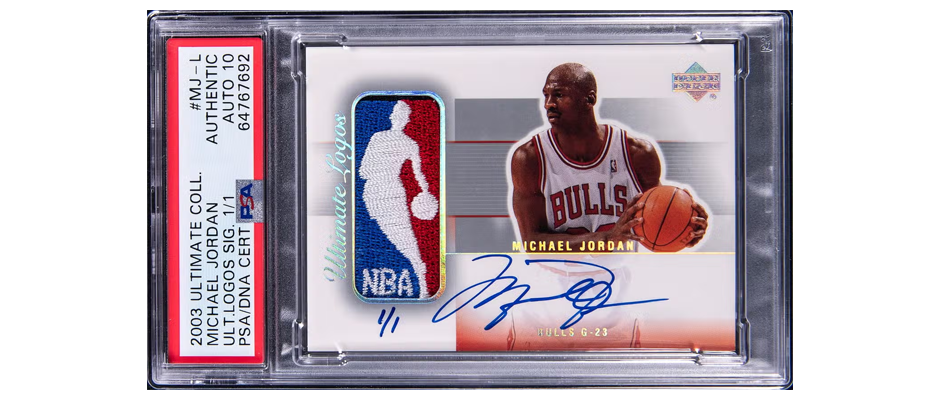
This is where things get both exciting and a little intimidating. The Michael Jordan auto card market covers an absolutely enormous range — from cards accessible to collectors with a few hundred dollars right through to pieces that belong in wealth management portfolios rather than binders.
At the entry level, Upper Deck’s modern Jordan autograph releases through their Goodwin Champions and SP Authentic lines put a genuine Jordan signature in the $300–$800 range depending on the specific card, print run, and condition. Upper Deck has featured Jordan on hundreds of autographed basketball cards over the last decade, and his signed collectibles command big money — often reaching four-digit prices without much trouble. For a newer collector, the Goodwin Champions auto is the classic starting point — clean design, authenticated signature, genuine scarcity, and an affordable enough entry point that you’re not betting your rent money on one card.
In the mid-range, you’re looking at numbered auto patch cards from products like Upper Deck Exquisite and SP Game Used, typically sitting in the $2,000–$15,000 territory depending on the print run and patch quality. The 1997 Upper Deck Game Jersey auto, numbered to just 23 to match Jordan’s jersey number, is one of the most iconic mid-range Jordan autos available — and remains a benchmark card that collectors aspire to. I’ve been chasing one of these for two years and they don’t come up for sale often, which tells you everything you need to know about demand.
At the high end, the numbers become genuinely staggering. Michael Jordan’s iconic 1986-87 Fleer rookie card graded PSA 9 with a perfect Auto 10 sold for $2.7 million in 2025, while a 2006-07 Upper Deck Michael Jordan and LeBron James dual Logoman 1/1 sold privately for $10 million. These are not cards most of us will ever own, but they set the ceiling for the market and they matter because they demonstrate that Jordan’s card values have no visible ceiling at the top end.
| Card | Approx. Price Range | Notes |
|---|---|---|
| UD Goodwin Champions Auto | $300–$800 | Best entry-level Jordan auto |
| UD SP Authentic Auto /23 | $2,000–$8,000 | Numbered, iconic |
| UD Exquisite Auto Patch | $5,000–$25,000+ | Premium mid-range |
| MJ-LeBron Dual Logoman 1/1 | $10,000,000 | Private sale, 2025 |
| MJ-Kobe Dual Logoman 1/1 | $12,930,000 | Auction record, 2025 |
How Much Is a Cooper Flagg Rookie Auto Worth Right Now?
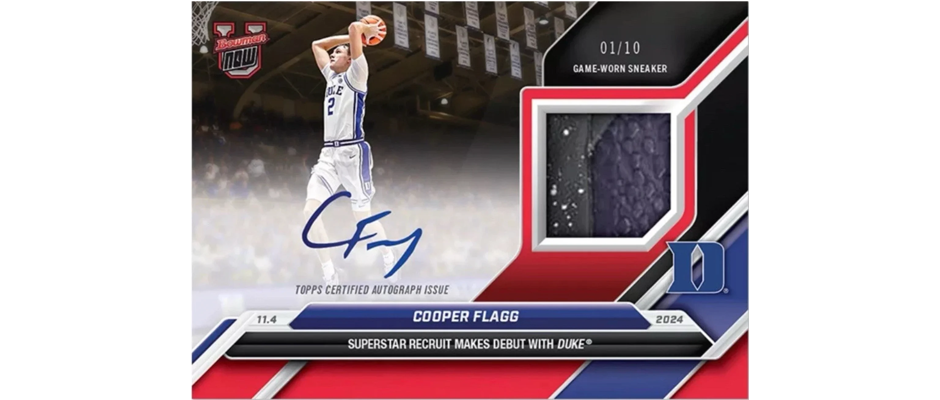
Cooper Flagg’s auto market is moving fast and the range is already impressive for a player who’s only a few months into his NBA career. Early sales from November 2025 showed his Topps Chrome Mojo auto selling for $3,000, his Rookie Photo Shoot Auto SSP fetching $2,700, and his New School Foilfractor 1/1 setting a high-water mark at $7,055. Those are not modest prices for a debut-season rookie.
What’s particularly interesting is how the market has differentiated between on-card autos and sticker autos. Collectors have been flocking to on-card Flagg autos — even the non-numbered varieties — with one selling for $1,949, almost three times what a numbered /99 sticker auto sold for just four days apart. That premium on on-card signatures is real and it reflects what serious collectors value: genuine pen-to-card authenticity rather than a sticker applied after signing. If you’re picking a Flagg auto to hold, on-card should be your priority over sticker versions every time.
The mid-range of the Flagg market sits around his Contemporary Marks RC and New Applicant Auto, with the Contemporary Marks RC selling for $562 across seven bids and Chrome Mojo parallels ranging from $900 to $3,000 depending on the specific number and condition. His base Topps flagship Real One auto has been sitting in the $500–$800 range, which is a meaningful entry point but not unreachable for a serious collector.
Across his top five sales, Flagg’s cards have accumulated over $600,000 in value — remarkable for someone less than a half season into his NBA career. The question, of course, is whether that value holds and grows, or whether it softens as rookie hype stabilises. More on that shortly.
| Card | Approx. Price Range | Notes |
|---|---|---|
| Topps Flagship Real One Auto | $500–$800 | Base auto, best entry point |
| Contemporary Marks RC | $500–$650 | Mid-tier on-card auto |
| Chrome Mojo /10 or /68 | $900–$3,000 | Premium parallel, high liquidity |
| Rookie Photo Shoot Auto SSP | $2,500–$3,000 | SSP premium, very popular |
| New School Foilfractor 1/1 | $7,000+ | 1-of-1, auction territory |
What Happened to Card Values After Past NBA Rookies Peaked?
This is the question that every Flagg investor needs to sit with honestly. The history of NBA rookie card markets is littered with cautionary tales — cards that spiked hard on draft buzz and early hype, then settled back to a fraction of their peak within 12 months. Understanding those patterns is essential before you commit serious money to any rookie auto.
The good news is that the players who sustain card values tend to share a few common traits: elite draft position, immediate on-court impact, playing for a major market team, and demonstrating the kind of two-way versatility that translates across eras. LeBron James is the ultimate example — his rookie cards from 2003-04 have only ever gone up over 20 years. Victor Wembanyama’s early cards spiked at draft time, dipped slightly post-release as supply hit the market, and have been climbing steadily since as his on-court dominance became undeniable. Luka Dončić followed a similar arc.
The cautionary tales are the players who generated real hype but couldn’t sustain it on the court. Injured rookies saw their card values crater in 2025, with names like Jayden Daniels experiencing declines near 50 percent post-injury — a stark reminder that a single piece of bad luck can undo months of market appreciation overnight. The difference between a Flagg scenario and a Daniels scenario isn’t talent — it’s health and longevity.
The boom-and-stabilise pattern is the most common trajectory for elite rookies. Cards spike at draft time, spike again at the product release, potentially spike again at Chrome release, and then find a floor that’s usually above the pre-draft price but below the peak. For players who become genuine stars, that floor keeps rising year after year. That’s the bet you’re making with Flagg — not that his cards are at their peak now, but that the floor in five years is significantly higher than it is today.
Are Michael Jordan Cards a Safe Long-Term Investment?
Let’s be honest about what “safe” means in this context. No card investment is entirely safe because markets shift, collector tastes change, and economic downturns affect discretionary spending. But relative to the rest of the sports card hobby, Michael Jordan autos are about as close to blue-chip as it gets.
Jordan cards were identified as the safest high-end asset in the 2025 card market, with steady demand for vintage pieces throughout the year and overall liquidity remaining strong — topping $100 million in major sales. The reason Jordan sustains this is simple: his legacy is completely settled. There is no performance risk. There is no sophomore slump. The GOAT debate is never going away, and as long as basketball remains the global sport it is, Jordan cards will have a global audience of collectors and investors chasing them.
The liquidity advantage is real and it matters. A Jordan auto at any price point has buyers. If you need to sell quickly — which sometimes happens — a Jordan card moves faster and at closer to market value than almost any other card in the hobby. That’s not true of many rookie cards, where you might need to wait for the right buyer or accept a significant haircut on a quick sale.
The one honest concern with Jordan autos is supply. Upper Deck has held the exclusive Jordan signing rights for over 30 years, and they’ve produced a lot of Jordan autographed cards across a lot of products over that time. Jordan appears on hundreds of Upper Deck autographed cards across more than a decade of releases — which means you need to be selective about which Jordan auto you buy. A numbered, low-print-run auto from a premium product is a very different investment to an open-edition auto from a mass-market set. The scarcity of the specific card matters enormously for long-term value.
Is Cooper Flagg’s Card Market Sustainable or Just Hype?
This is the big one, and honestly it’s where I’ve spent the most time doing my research before writing this section. Because the answer isn’t a simple yes or no.
The case for Flagg being the real deal, not just hype, is strong. He leads all rookies in defensive ratings with a 113.1, and is averaging 18.9 points per game, 6.5 assists, and 4.2 rebounds — leading his team in overall points, rebounds, and assists. For a 19-year-old in his first NBA season, those numbers are extraordinary. Topps Ripped noted that his early-season matchup against Victor Wembanyama was “must-see TV,” further solidifying his brand value — and brand value is what ultimately drives card prices over the long haul.
Rookies like Cooper Flagg saw 20 to 50 percent gains in card values after his early-season performances, positioning him as one of the standout sports card investments heading into 2026. That price appreciation has been driven by genuine on-court performance, not just pre-season buzz — which is a fundamentally healthier foundation for value than hype alone.
The risks are real though. Injury is the single biggest one — it can’t be predicted and it can crater a market overnight. Overproduction is the second concern. Topps, backed by Fanatics, has the capacity to print significant volume, and if the hobby gets flooded with Flagg product across Chrome, Finest, Midnight, and every other Topps basketball release, the base-level cards will face supply pressure. The answer to that risk is to focus on numbered parallels and on-card autos rather than open-edition base cards. Even a Rare Gold Flagg parallel could be more structurally scarce than a Common-tier colour parallel long-term — and that nuance matters for collectors making targeted purchases rather than just grabbing whatever’s available.
Jordan Auto vs Flagg Auto — A Side-by-Side Comparison
Let’s put it all on the table. Here’s how these two investment options compare across the metrics that matter most.
| Factor | Michael Jordan Auto | Cooper Flagg Auto |
|---|---|---|
| Entry price | $3000 –$8000 (modern autos) | $500–$800 (base flagship) |
| Ceiling | Virtually unlimited (1/1s in millions) | $7,000+ now, open-ended long term |
| Liquidity | Excellent — sells fast at any price point | Strong now, dependent on performance |
| Risk level | Low — legacy is fully established | Moderate to high — injury and market risk |
| Best time horizon | 5–10 years (already proven) | 10–20 years (trajectory play) |
| Supply concerns | Moderate — many modern autos in circulation | Moderate — Topps volume uncertain |
| Who it suits | Conservative collector/investor | Growth-oriented, higher risk tolerance |
The right choice honestly depends on what you’re trying to do. If you want a card that will almost certainly be worth more in 10 years than it is today, and you want to be able to sell it quickly if you need to, a Jordan auto is the safer play. If you want the possibility of a 5x or 10x return on the right Flagg card and you’re comfortable holding through the volatility of a rookie’s development, Flagg offers upside that Jordan simply can’t at current price levels.
My personal take? At a $500–$800 budget, I’d actually lean Flagg, specifically an on-card auto from the Topps flagship. The upside is real and the entry price is lower than most quality Jordan autos at that same level. If I had $2,000–$5,000 to invest, I’d split it — a lower-numbered Flagg parallel and an entry-level numbered Jordan auto — and I’d sleep well at night with both.
What Is the Cheapest Michael Jordan Auto Card I Can Buy?
For collectors who want Jordan ink without breaking the bank, the modern Upper Deck auto market is the place to start. Upper Deck’s annual Goodwin Champions set typically features a Jordan auto in the $300–$600 range for an ungraded copy, making it genuinely the most accessible point of entry into the Jordan auto market. The design is clean, the signature is authenticated, and it’s a real Jordan auto — not a facsimile or a reprint.
The Upper Deck SP Authentic range also produces open-edition and limited Jordan autos in the $400–$900 range depending on the year and print run. These are widely available on eBay and through established card marketplaces like PWCC and Goldin. For the best prices, watching eBay completed sales over a few weeks gives you a genuine sense of market value before you commit.
One critical caution: the Jordan auto market attracts fakes. There are well-documented signs of counterfeit Michael Jordan cards circulating in the hobby, including forged signatures on unsigned cards and fake authentication stickers. Always buy Jordan autos with a provable chain of authentication — Upper Deck Authenticated (UDA) holograms, PSA/BGS certification, or from highly reputable sellers with extensive track records. If a deal looks too good to be true, it almost certainly is. I’d rather pay a little more from a trusted source than risk buying a fake at a discount.
For tracking current Jordan auto prices and completed sales, Sports Card Investor and Sports Collectors Digest are both excellent real-time resources.
Which Cooper Flagg Auto Cards Are the Best Investment Right Now?
Not all Flagg autos are created equal, and picking the right one matters more than just picking any Flagg auto. Here’s how I’d approach it across different budget levels.
For the $500–$800 budget, the Topps Flagship Real One Auto is the starting point. It’s an on-card auto, it’s the official first Topps licensed NBA Flagg signature, and it has the historical significance of being part of the set that marked Topps’ return to NBA licensing after 15 years. Flagg appears on multiple on-card autos in the 2025-26 Topps release, including Contemporary Marks, New Applicant Auto, and Havoc Marks Rainbow Foil — all of which are drawing premium prices and all of which carry the on-card premium over sticker alternatives.
For the $900–$3,000 budget, the Chrome Mojo parallels are the standout pick. Both the /10 and /68 Chrome Mojo versions have proven to be among the most liquid and valuable Flagg cards in the market, with consistent sales across a range of conditions and auction timings. The scarcity of the /10 gives it more long-term ceiling, but the /68 is a more realistic acquisition target and still carries strong collector demand.
For the $3,000+ budget, the Rookie Photoshoot Dual Autos — featuring Flagg alongside Dylan Harper, Ace Bailey, or Kon Knueppel — are genuinely exciting long-term hold pieces. If either Flagg or his dual partner becomes a perennial All-Star, dual auto cards from rookie year tend to appreciate dramatically. These are the kinds of cards that get featured on hobbyist YouTube channels in 10 years under the title “I can’t believe this sold for only $3,000.”
The one thing I’d add: keep a close eye on the Topps Chrome release when it drops. Collectors appear to be waiting for the new influx of Cooper Flagg autos in Topps Chrome rather than spending heavily on paper autos right now — which means the Chrome release could trigger a second significant wave of demand and price movement for Flagg’s most coveted cards.
For a full breakdown of the current Flagg auto market across all Topps products, MagPro Supplies has the most detailed sales tracking I’ve found, and Cardlines breaks down the Finest product specifically in excellent detail.
Air Jordan vs Air Flagg: The Verdict Is In
So, is it better to invest in a Michael Jordan auto or a Cooper Flagg auto? Here’s the honest summary.
If you want stability, proven liquidity, and the peace of mind that comes from owning a piece of the most decorated name in basketball card history, buy a Jordan auto. It doesn’t have to be expensive — even a $400 Goodwin Champions Jordan auto is a legitimate piece of hobby history with a decades-long track record of holding and growing value. Vintage icons like Jordan remain the gold standard for long-term wealth preservation in sports cards, and that’s not going to change.
If you want upside, excitement, and the chance to own a card that could be worth multiples of today’s price if Cooper Flagg becomes the player everyone believes he’s going to be, buy a Flagg on-card auto now — before the Topps Chrome wave hits and before a second full season of elite performances pushes prices higher. Flagg is the premier buy for 2026, with his performance for the Mavericks and the subsequent rise in card value indicating a high-ceiling investment — though as always, the risks linger from injuries and potential overproduction.
The best answer, if your budget allows, is actually both. A Jordan auto for the foundation, a Flagg on-card auto for the ceiling. That’s the kind of balanced approach that makes sense whether you’re a pure collector or someone who’s genuinely thinking about cards as part of a broader portfolio strategy.
Which side of this debate are you on? Are you a Jordan all-day kind of collector, or are you betting on Air Flagg? Drop your pick in the comments below — I’d genuinely love to hear how other Aussie collectors are approaching this one. And if you’ve recently pulled or purchased a Flagg or Jordan auto, share the details. Best pulls always make for the best stories!
This article is for informational and collecting purposes only. Card market values are volatile and subject to change. This is not financial or investment advice. Always do your own research before making significant purchases in the hobby.