Here’s a fact that should make every graded card collector sit up straight: PSA slabs, by most community tests, block roughly 5% of UV light. That means 95% of the ultraviolet radiation hitting your shelf every single day is passing straight through your slab and landing on your card. The colour fading that happens as a result isn’t dramatic or sudden, it’s slow, quiet, and completely irreversible by the time you notice it.
The best UV-resistant display case for graded cards is the single most important upgrade a collector can make after getting their slabs back from the grading company. A quality display case does two things brilliantly: it stops the slow fade that ruins visual appeal and resale value, and it turns your graded cards into something worth showing off rather than just storing. In a survey of graded card collectors, 78% cited UV and physical protection as their primary reason for buying a display case, and it’s easy to see why once you understand what ambient light does over time.
In this guide, we’ll cover why UV is such a serious threat, the dirty truth about PSA slab UV protection, what percentage rating to look for, and the best display cases available right now for single slabs, wall collections, BGS holders, and every budget. Let’s get into it!
Why UV Light Is the Silent Killer of Graded Card Collections
UV damage is the ultimate patience play – it doesn’t wreck your cards overnight. It chips away quietly over weeks, months, and years of ambient light exposure, and by the time the damage is obvious enough to notice, it’s permanent. That’s what makes it so insidious for collectors who think a PSA slab is the last word in card protection.
Here’s what UV radiation actually does to your cards in practical terms. Holographic cards lose their shimmer first – the metallic foil layer that creates that rainbow effect degrades under UV exposure, and a holo Charizard or a refractor rookie that once caught light from every angle starts looking flat and washed out. Chrome and refractor finishes dull next, as the reflective coating breaks down and that mirror-like finish gradually turns hazy. For vintage cards, reds and yellows fade unevenly, leaving a desaturated, ghostly look that tanks both visual appeal and resale value. Even white card borders yellow at the edges over time, making a technically graded card look older and more worn than its label suggests.
The tricky part is that not all UV exposure comes from direct sunlight. Fluorescent overhead lights, LED light strips, and even the ambient brightness of a well-lit room all contribute UV radiation in smaller doses. A card sitting on a shelf in a room with a window isn’t safe just because it’s not in direct sunlight. It’s getting a lower dose, but it’s getting it all day, every day, and compounding is a real thing.
The good news is that genuine UV protection is now cheap and widely available. There’s absolutely no reason to display a graded card without it. As noted in the Fanarch display case guide, even one summer of window light can soften ink and fade a prized rookie – but place that slab behind acrylic that blocks 96 to 98 percent of UV, and the risk almost disappears. For a deeper look at the specific types of UV damage across different card finishes, Phantom Display’s buyer’s guide covers it in excellent detail.
Do PSA Slabs Actually Protect Against UV Light?
Short answer: not really, and this surprises a lot of collectors who assume that once a card is sealed in a slab it’s fully protected from everything. PSA slabs are brilliant at physical protection – handling damage, bending, edge wear, dust, moisture, and accidental contact. That’s what they’re engineered to do. UV protection simply wasn’t part of the brief.
Community testing posted on forums and Reddit consistently measures PSA acrylic at around 5% UV filtration, leaving approximately 95% of harmful UV rays reaching the card inside. Acrydis, who manufactures aftermarket slab cases, states on their product page that PSA slabs only offer around 13% protection against UV rays based on their testing – and even that more generous figure is nowhere near the 96 to 99 percent that a quality display case provides.
It’s worth noting that BGS and CGC slabs perform slightly better in some community tests, but none of the major grading companies provide official UV protection specs for their acrylic cases. As Cheevo explains in their UV protection guide, graded card slabs are not designed to provide meaningful UV protection, and display was never part of the slab’s original design brief. Physical protection and UV protection are different problems that are solved by different products.
This is actually fine – it just means the responsibility sits with the collector to pair their slabs with proper display cases. The slab does its job. The display case does a different job. Together, they give your collection genuine comprehensive protection. For more on this topic, the Cheevo UV guide is one of the clearest plain-language explanations out there.
What Percentage UV Protection Do I Need in a Display Case?
The museum standard is 99% or higher, and that should be your minimum threshold when evaluating any display case for a graded card you care about. Museum-grade acrylic such as Tru Vue Optium blocks up to 99% of UV light at just 3mm thick. The premium display case brands in the hobby have adopted this same standard – Phantom Display’s cases offer 99.6% UV protection and Slabmags’ aluminium alloy cases are lab-tested at 99.9%.
One important warning: “UV resistant” or “UV safe” on a product listing with no percentage tells you nothing. This is one of the most common ways budget case manufacturers mislead buyers – using UV-language in marketing without disclosing actual filtration specs, because the honest answer is usually somewhere between “not enough” and “nothing useful.” If a display case can’t tell you exactly what percentage of UV it blocks, that’s your first red flag.
Acrylic quality matters beyond just the UV spec. Cast acrylic holds clarity and resists internal yellowing better than extruded acrylic over the long term – the difference isn’t obvious at purchase but becomes visible after several years of display. Premium display cases use cast acrylic specifically for this reason. Thickness per panel also matters: 10mm per side is the premium standard for serious collectors, offering superior optical clarity and meaningful impact resistance alongside UV filtering. Budget cases at 2 to 3mm look fine on day one and often start yellowing within a year.
What Is the Best UV-Resistant Display Case for a Single Graded Card?
This is the question most collectors are asking, and the good news is there are several genuinely excellent options at different price points. Here’s a rundown of the best single-slab UV-resistant display cases available right now.
Phantom Display Magneto
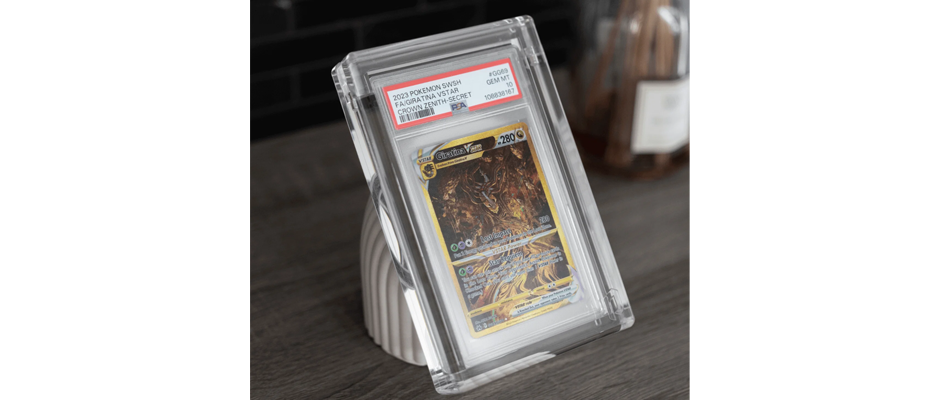
The Magneto gets the fundamentals right: 99.6% UV-protective acrylic, a magnetic closure that opens in seconds, and construction that doesn’t cloud or yellow over time. It fits standard-thickness PSA, BGS, CGC, and SGC slabs, and the patent-pending embedded iron core magnetic mounting system means you can display it on a desk, then snap it onto a wall mount later without buying a new case. If you use GradedGuard bumpers or Slabmag holders on your slabs, Phantom makes dedicated Magneto GradedGuard and Magneto Slabmags variants built to fit those specific protector dimensions. Trusted by Fanatics Collect, eBay Live, and Heritage Auctions, and rated 4.7 out of 5 by collectors.
Best for: Most collectors, all grading companies, desk and wall display, everyday PC cards and grails alike.
Phantom Display Ultra
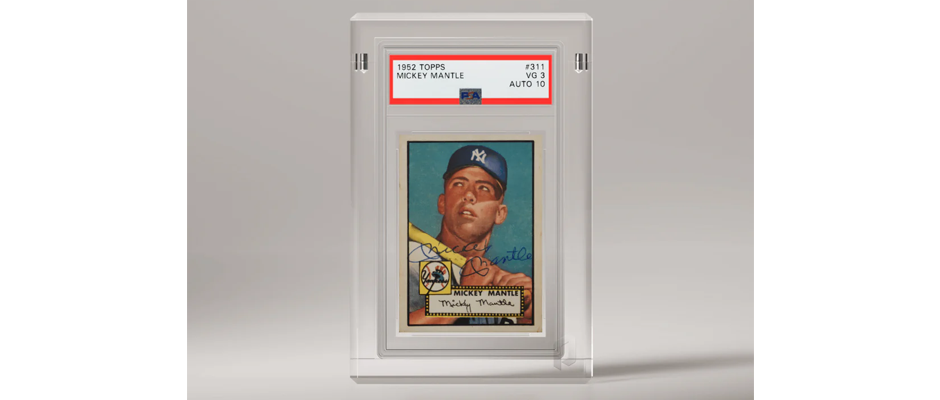
For high-value grails (cards worth $500 or more), maximum protection matters. The Ultra with its 10mm crystal acrylic per side gives you the thickest shield against UV, impacts, and environmental damage. Available in Rounded and Prism exterior styles, both using the same 99.6% UV-protective cast acrylic and neodymium magnetic closure. The Prism’s faceted diamond-inspired design in particular is genuinely stunning on a display shelf – it elevates the card rather than framing it.
Best for: High-value grails, collectors who want maximum UV and physical protection, premium desk display centrepieces.
Card Shellz Hero Diamond Shell
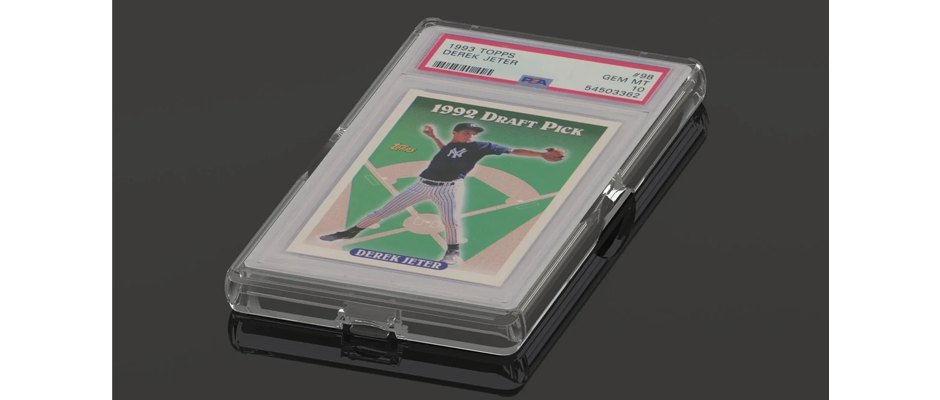
The Hero Diamond Shell is made from ultra-strong polycarbonate that’s 30× stronger than acrylic, and each case provides 100% UV protection to help prevent fading and yellowing over time. Card Shellz backs it with a 365-day full refund guarantee. One limitation to know: it’s engineered specifically for PSA slabs and won’t fit BGS, CGC, or other graders’ holders. If your collection is primarily PSA and you want the toughest case on the market, this is it.
Best for: PSA collectors, shipping and transport protection, collectors who prioritise impact resistance.
Slabmags Aluminium Alloy Case
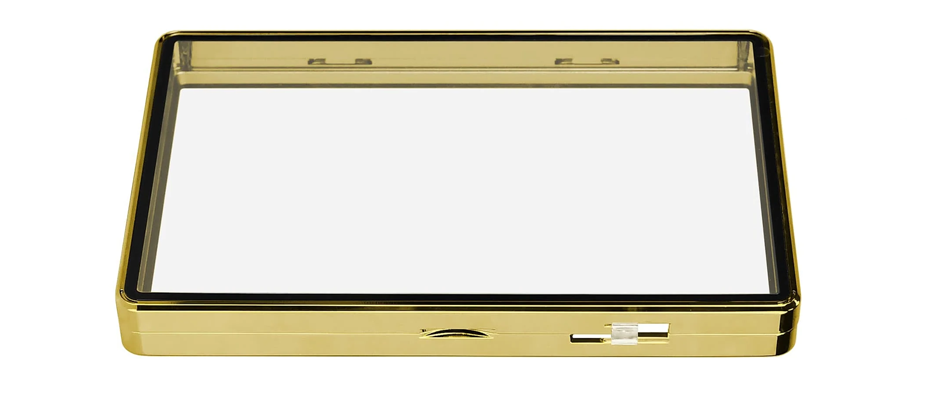
Slabmags graded card cases are lab-tested to be 99.9% UV protective, ensuring your valuable cards are safeguarded against harmful UV rays. Designed for all major grading companies – PSA, BGS, SGC, TAG, and CGC – with matte, metallic, and gradient finishes available in multiple thickness options. The aluminium alloy construction is the real point of difference – premium, weighty, and completely different in aesthetic to acrylic display cases. If you want something that looks like a luxury product on a shelf, Slabmags delivers it.
Best for: Collectors who want a premium metal look, multi-grader collections, display pieces for high-value slabs.
Slab Saver Single Display Stand
UV protected and lab-tested to block up to 99% of harmful UVA and UVB rays that cause fading and discoloration. Made from high-clarity acrylic that resists yellowing and clouding over time, with a precision design specifically for PSA graded card slabs and a built-in stand for desk or shelf display. Self-contained, no separate mount required, and at a slightly lower price point than the Magneto. A clean, no-fuss option.
Single Slab Display Case Comparison Table
| Product | UV Protection | Material | Graders Supported | Best For |
|---|---|---|---|---|
| Phantom Magneto | 99.6% | Cast acrylic | PSA, BGS, CGC, SGC, TAG | Most collectors, wall/desk |
| Phantom Ultra | 99.6% | 10mm cast acrylic | PSA, BGS, CGC, SGC, TAG | Grails, premium desk display |
| Card Shellz Diamond Shell | 100% | Polycarbonate | PSA only | Drop protection, shipping |
| Slabmags Alloy Case | 99.9% | Aluminium alloy | PSA, BGS, SGC, TAG, CGC | Premium metal aesthetic |
| Slab Saver Stand | 99% | Optical acrylic | PSA only | Simple desk display |
Are Cheap Amazon Display Cases Good Enough for Graded Cards?
The short answer is: it depends entirely on the card inside. For bulk commons, duplicates, or slabs you picked up for a few dollars – a budget Amazon case is probably fine as a temporary measure. For anything worth $50 or more, or anything you’re planning to display long-term and eventually sell, a generic cheap case is a genuine risk.
When you see a display case marketed as “universal” or “fits all graded cards,” that means it is sized to accommodate the largest slab on the market. Every smaller slab gets a loose fit. Some sellers add foam inserts to compensate, but a foam shim is a band-aid for a fundamental design problem. A rattling slab creates micro-scratches on its corners over time – slow damage, but damage.
The UV problem is equally serious. Budget cases marketed on Amazon and eBay rarely mention UV properties at all, because there is nothing to mention. Standard acrylic without UV-inhibiting additives offers minimal protection against the wavelengths that cause fading. You’re effectively paying for something that looks like protection from the outside but isn’t providing it where it counts.
The acrylic itself on budget cases is typically extruded rather than cast, and thin – often 2 to 3mm per panel. Extruded acrylic starts yellowing noticeably within 12 to 18 months of display, which is deeply ironic for a product sold to preserve your card’s visual quality. Spend the extra $30 to $40 on a quality case for anything worth keeping. You’ll thank yourself later.
What Is the Best Display Case for BGS Subgrade Slabs?
BGS slabs are slightly thicker than PSA slabs, particularly the subgrade versions with the inner label showing your centering, corners, edges, and surface scores. A standard PSA case will not fit a BGS subgrade slab properly – the extra thickness causes the case to either not close fully or put pressure on the slab, which defeats the purpose of the whole exercise.
If your collection skews toward Beckett grades, especially BGS 9.5 or BGS 10 slabs with subgrade labels, the Phantom Magneto Thick is the version to buy. Standard Magneto for PSA/CGC/SGC, Thick for BGS. The two cases are otherwise identical in spec.
The principle here is straightforward: always check whether the display case you’re ordering is engineered specifically for your grader’s slab dimensions, not just “compatible” in the loose sense. A grader-specific fit eliminates rattle, prevents slab corner damage, and means the UV-protective acrylic is doing its job as a sealed unit rather than letting ambient air circulate freely around a loose-fitting slab.
What Is the Best Wall-Mount Display Case for a Graded Card Collection?
A wall of graded cards done right is one of the most satisfying things in the hobby. Ten or twenty PSA 10s in a clean gallery layout turns your collection space into something worth showing off – and with the right hardware it genuinely looks like a curated exhibition rather than a storage solution.
For individual slab wall display, the Phantom Magneto combined with the Phantom Wall Mount system is the standout option. The embedded iron core snaps to 3M adhesive-backed wall mounts, creating a floating card effect where the mount is virtually invisible from the front. You can rearrange cards, swap pieces in and out, and adjust your layout without drilling new holes or leaving adhesive patches all over your walls. Each mount holds one Magneto case securely. A gallery of 10 to 15 of these on a feature wall genuinely looks great.
For multi-card wall frames, Pennzoni Display Co.’s handcrafted hardwood cases hold up to 12 graded cards, come in black, cherry, walnut, and golden oak finishes, include 2 brass locks with a key for added security, and provide 100% UV protection via a crystal clear acrylic door that wards off harmful sun damage and keeps cards dust-free. Pennzoni also offers a 50-card version for serious collection walls. The hardwood aesthetic gives a premium gallery look that acrylic single-slab cases can’t match, and the UV-filtering door protects the whole collection behind one panel.
What Other Factors Matter Beyond UV Protection?
UV protection is the most important spec, but it’s definitely not the only one worth thinking about when choosing a display case. Here’s what else matters.
The closure mechanism determines how safe your slab is every time you access the case. Magnetic closures, like those on Phantom Display cases, are the gold standard -instant, tool-free, and zero pressure on the slab. Hardware-based screw closures create pressure points that can stress the acrylic over time. Snap closures are acceptable for lower-price options but rarely achieve the same fit precision.
Slab fit precision is the difference between a case that genuinely protects and one that allows subtle corner damage from slab movement. Precision-engineered cases sized for a specific grader’s dimensions eliminate rattle entirely. “Universal fit” cases, as discussed, rarely achieve this without foam shims.
Acrylic clarity over time separates quality cases from budget ones in ways that aren’t visible at purchase. Cast acrylic holds its optical clarity for years. Extruded acrylic yellows within 12 to 18 months, creating its own colour cast over the card – the opposite of what you’re trying to achieve.
Finally, think about layered protection. A display case works best as the outer layer of a full system: sleeve directly on the acrylic slab, a GradedGuard rubber bumper or Slabmag holder over that for impact absorption, then the display case as the UV and presentation layer. Each product addresses a different threat, and together they give your graded cards comprehensive coverage. For more detail on the full layered protection approach, Slabmags’ protection guide breaks it down clearly.
Step-by-Step: How to Set Up the Perfect UV-Resistant Display for Your Graded Cards
Getting your display setup right doesn’t need to be complicated. Here’s the exact process I follow for every card that comes back from a grading submission.
Step 1: Sleeve the slab immediately. The moment your graded card arrives, slip a quality OPP glove-fit sleeve – Card Shellz Glove-Fit or Cardboard Gold Perfect Fit – directly onto the acrylic. This protects the slab surface from fingerprints, dust, and micro-scratches during all handling before the display case goes on.
Step 2: Decide on additional protection. For high-value cards or slabs you’ll be transporting to shows, consider adding a GradedGuard rubber bumper or a Slabmag holder between the sleeve and the display case. These add a layer of impact absorption that genuinely matters.
Step 3: Choose the right display case. Match the case to the grader and the card value. Standard PSA: Phantom Magneto. BGS subgrade: Phantom Magneto Thick. Premium grail: Phantom Ultra 10mm. Budget/duplicate: Phantom Nano. Multi-card wall feature: Pennzoni hardwood wall case. Card going in the post: Card Shellz Hero Diamond Shell.
Step 4: Position away from direct light. No direct sunlight, ever. Avoid positioning cards opposite windows where they’re in the line of a light beam during the day. If your display room has significant natural light, position cards on the same wall as the window rather than the opposite wall. Avoid fluorescent strip lighting pointing directly at display cases.
Step 5: Review your setup annually. Check each display case for developing scratches or cloudiness on the acrylic. Replace slab sleeves annually for cards you handle regularly. Add a silica gel pack to your storage area during summers when humidity rises. Verify no slabs have developed rattle inside their cases.
That’s the full process. About five minutes per card to do properly, and genuinely worth every second for anything of real value in your collection.
Lights Out: Protecting Your Grades for the Long Game
So, what is the best UV-resistant display case for graded cards? For most collectors, the answer is the Phantom Display Magneto. It gets the fundamentals right: 99.6% UV-protective acrylic, a magnetic closure that opens in seconds, and construction that doesn’t cloud or yellow over time. It fits standard-thickness PSA, BGS, CGC, and SGC slabs. At $55 to $60, if you’ve spent hundreds on grading fees, this is the logical conclusion of that investment.
For high-value grails, step up to the Phantom Ultra’s 10mm crystal acrylic. For PSA collectors who prioritise impact protection, the Card Shellz Hero Diamond Shell is the toughest option on the market. For a premium metal aesthetic across all graders, Slabmags delivers something genuinely different. And for multi-card wall displays that look like a room feature rather than a storage solution, Pennzoni’s hardwood cases are hard to beat.
Whatever you choose, please don’t leave a graded card you worked hard to acquire sitting in ambient light without proper UV protection. The fading is real, it builds slowly, and it’s completely preventable. Your PSA 10 deserves better than a budget Amazon case that’ll yellow by next summer and barely filters enough UV to matter.
What does your display setup look like right now? Drop it in the comments – whether it’s a single grail on a desk stand or a feature wall of 50 slabs, I genuinely love seeing how other collectors are showing off their collections. And if there’s a display case product you swear by that I haven’t covered here, please share it. The more options collectors know about, the better!