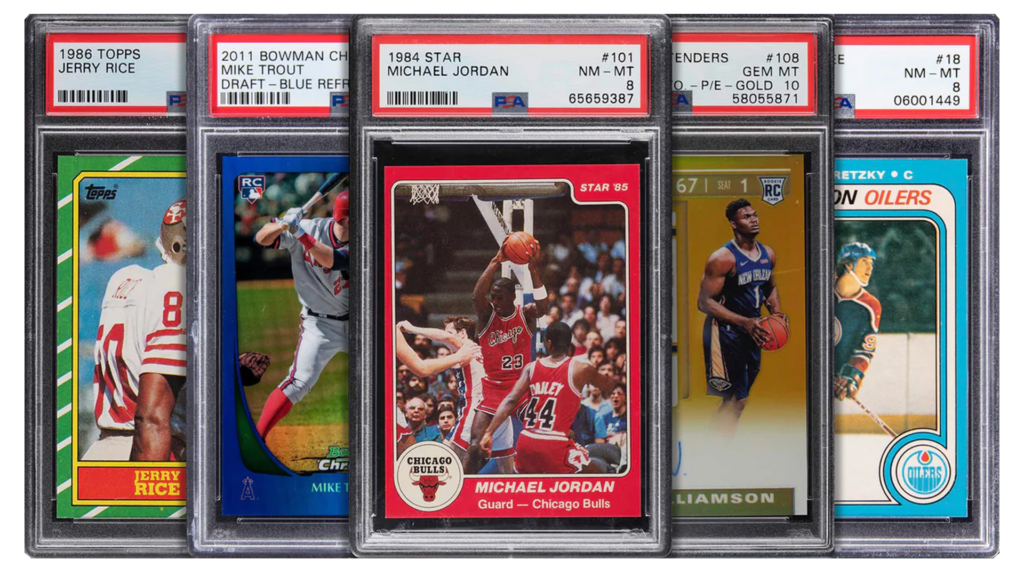
I’ll never forget submitting what I thought was a guaranteed PSA 10 Cooper Flagg Topps Chrome rookie with razor-sharp corners, flawless surface, and pristine edges. When it came back as a PSA 9, I was devastated. The only flaw noted? Centering measured 62/38 on the front. That tiny 2% deviation from the 60/40 threshold cost me roughly $150 in lost value and the difference between a PSA 10 selling for $400 and a PSA 9 selling for $250. That expensive grading lesson taught me what every serious collector eventually learns: centering isn’t just one grading criterion amongst four, it’s often the most unforgiving factor that separates gem mint cards from merely mint ones.
Centering might seem like an arbitrary aesthetic preference, but its impact on card values is mathematically undeniable and financially devastating when ignored. A perfectly centred card commands premiums of 50-300% over equivalent cards with off-centre borders, and grading companies weight centering heavily enough that perfect corners, edges, and surface still yield PSA 8s or lower if centering falls outside narrow tolerances.
In this comprehensive guide, I’ll explain exactly what centering is and how it’s measured, reveal why grading companies prioritise it so heavily, show you the shocking value differences centering creates, and help you avoid the costly mistake of submitting off-centre cards that can never achieve the grades you need.
What Is Centering and How Is It Measured?
Before understanding why centering is crucial for high-value cards, you need to grasp what centering actually means and how grading companies evaluate it.
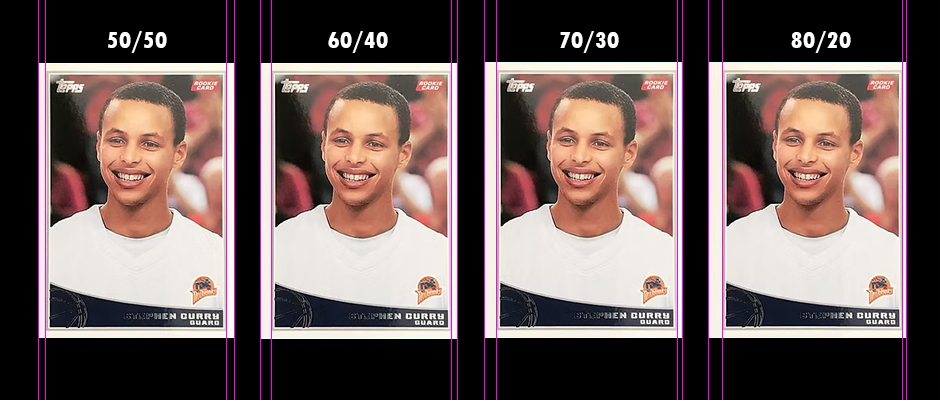
Centering refers to the placement of the printed image within the card’s borders. A perfectly centred card has equal border widths on all sides – 50% on left/50% on right, 50% on top/50% on bottom. This creates visual symmetry that’s aesthetically pleasing and indicates quality manufacturing.
However, perfect 50/50 centering is extremely rare. Manufacturing tolerances mean most cards exhibit some degree of off-centre printing. The question becomes: how much deviation is acceptable before it affects the grade?
How centering is measured:
Centering is measured by comparing border widths on opposite sides of the card and expressing the relationship as a ratio. If the left border measures 2mm and the right border measures 3mm, the centering ratio is 2:3, which converts to approximately 40/60 (the smaller number always goes first).
According to PSA’s centering determination method, you calculate centering by comparing measurements from left to right and top to bottom. The centering is designated as the percent of difference at the most off-centre part of the card. For example, if you measured Top-Bottom 55/45, 57/43 and Left-Right 70/30, 73/27, the largest number is 73, so 73/27 is the worst centred portion and determines the card’s final centering value.
Front versus back considerations:
Both the front and back centering matter for grading, though front centering carries significantly more weight because it’s what collectors display and view.
For PSA 10, front centering must not exceed 55/45 whilst back centering can be as loose as 75/25. This discrepancy acknowledges that backs are less visually important whilst still requiring reasonable centering standards.
I’ve had cards perfectly centred on front but significantly off-centre on back (72/28) that still achieved PSA 10 grades because the back fell within the 75/25 tolerance. However, I’ve never seen a card with perfect back centering but poor front centering (65/35) receive PSA 10, front centering is the limiting factor.
Why Do Grading Companies Weight Centering So Heavily?
Understanding the rationale behind centering’s importance helps explain why grading companies refuse to compromise on this criterion.
Historical perspective:
Centering standards emerged from the earliest days of card manufacturing when printing and cutting processes were imprecise. Well-centred cards indicated superior quality control and manufacturing precision where they were literally the best examples from production runs.
According to Card Hound Vintage’s analysis, PSA systematically tightened evaluation criteria over time, with the 55/45 centering requirement being informally implemented starting in 2022 before being officially announced in January 2025. This evolution reflects increasing market sophistication and collector expectations.
Aesthetic importance:
Human visual perception strongly favours symmetry and balance. Off-centre cards create visual discomfort because our brains immediately recognise the asymmetry. A card with thick borders on one side and thin borders on the opposite side looks “wrong” even to casual observers.
I’ve displayed both well-centred and off-centre cards side-by-side at card shows. The visual difference is striking, well-centred cards look professional and premium, whilst off-centre cards look amateurish even when other attributes (corners, surface, edges) are identical.
Manufacturing quality indicator:
Centering serves as a proxy for overall manufacturing quality. Cards that left the factory with poor centering often have other subtle defects, slightly misaligned printing, inconsistent colour registration, or imperfect cutting. Grading companies use centering as a quick visual indicator that the card represents the best possible production quality.
This is why grading companies recently tightened standards. PSA’s shift from 60/40 to 55/45 for PSA 10 aligns their standards with other major graders like SGC (which requires 55/45 front and back) and brings them closer to BGS’s strict 50/50 requirement for pristine grades.
How Much Does Centering Affect Card Value?
The financial impact of centering is enormous and often shocking to collectors who don’t understand how drastically values differ between grades.
PSA 10 versus PSA 9 comparisons:
The grade difference from PSA 10 to PSA 9 purely due to centering creates value gaps of 50-300% depending on the card. Let me illustrate with real examples:
Cooper Flagg 2025 Topps Chrome Base:
- PSA 10: $400-500
- PSA 9: $250-300
- Difference: $150-200 (60-67% premium for PSA 10)
Victor Wembanyama 2023-24 Topps Chrome Base:
- PSA 10: $800-1,000
- PSA 9: $400-500
- Difference: $400-500 (100% premium for PSA 10)
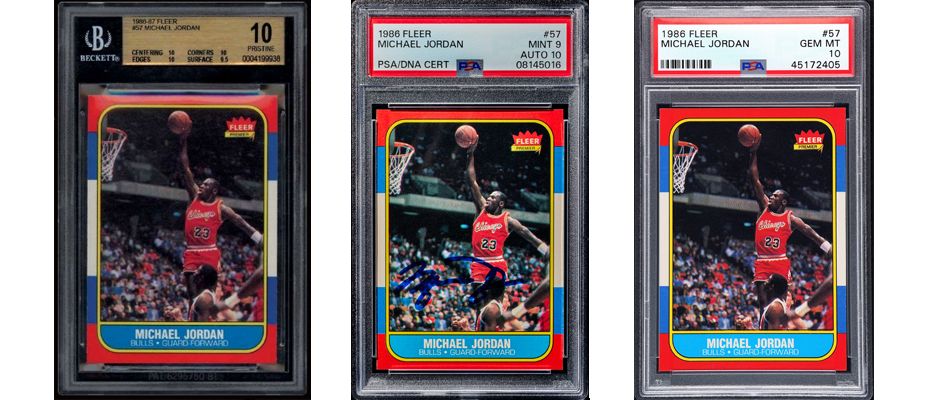
Vintage 1986 Fleer Michael Jordan:
- PSA 10: $260,000+
- PSA 9: $80,000-100,000
- Difference: $160,000-180,000 (160-225% premium for PSA 10)
These aren’t minor differences – we’re talking about thousands or even hundreds of thousands of dollars separating otherwise-identical cards purely because one has 55/45 centering whilst the other measures 62/38.
The premium pricing phenomenon:
According to market analysis, PSA claims that their graded cards sell for more than competitors 9 out of 10 times, with PSA 10 cards in particular selling for twice as much in 68% of sales. This premium partially reflects centering standards, PSA 10s with tight centering carry perceived quality that commands market premiums.
The rarer the card, the larger the centering premium. For modern mass-produced cards, PSA 10 might command a 50% premium over PSA 9. For rare vintage cards or low-numbered parallels, PSA 10 can command 200-300% premiums because perfectly centred specimens are exceptionally scarce.
Break-even analysis:
Centering creates break-even thresholds that determine whether grading makes financial sense. If a raw card is worth $25 and grading costs $22, you need the graded card to sell for at least $70-80 to justify the expense (accounting for selling fees). A PSA 10 might hit $150, making grading profitable. A PSA 9 might only reach $80-90, barely breaking even. A PSA 8 due to poor centering might sell for $40-50, resulting in a net loss.
I’ve submitted cards with borderline centering (59/41, 60/40) hoping for PSA 10s. When they came back PSA 9, the financial returns barely justified the grading fees. Had I properly measured centering beforehand, I could have saved the submission costs entirely.
What Are PSA’s Current Centering Standards?
PSA updated their official centering standards in early 2025, fundamentally changing what’s required for top grades. Understanding these current standards is crucial for submission decisions.
PSA 10 (Gem Mint) requirements:
According to PSA’s official grading standards, the image must be centred on the card within a tolerance not to exceed approximately 55/45 percent on the front, and 75/25 percent on the reverse.
This represents a significant tightening from historical standards. Previously, PSA allowed 60/40 front centering for PSA 10. The shift to 55/45 was implemented quietly, PSA slow-rolled this change by first stating gem centering was a “range” of 55/45 to 60/40, then saying “approximately 55/45,” and finally making the full leap to 55/45 as the standard.
PSA made this change without any announcement, simply updating their website. Collectors discovered the change by comparing current standards to archived versions via the Wayback Machine. The quiet implementation suggests PSA was concerned about market reaction to tightened standards affecting millions of previously graded cards.
PSA 9 (Mint) requirements:
PSA 9 requires centering of approximately 60/40 to 65/35 or better on the front and 90/10 or better on the reverse. This provides a reasonable buffer for cards with slight centering issues.
I find PSA 9 centering standards more forgiving and realistic for modern cards. A 62/38 centred card still looks good to the naked eye and represents quality manufacturing, making PSA 9 a respectable grade that maintains solid value.
PSA 8 (Near Mint-Mint) and lower:
PSA 8 allows 65/35 to 70/30 centering on front and 90/10 or better on back. Each grade level relaxes centering tolerances progressively:
- PSA 7: 70/30 to 75/25 front, 90/10 back
- PSA 6: 80/20 front, 90/10 back
- PSA 5: 85/15 front, 90/10 back
- PSA 4 and lower: 85/15 or 90/10 front and back
Off-Centre (OC) qualifiers:
When centering falls below the minimum standard for that grade, PSA designates the card “OC.” For example, a card that would be PSA 9 based on corners, edges, and surface but has 72/28 centering becomes PSA 9 OC.
The OC qualifier devastates value. A PSA 9 OC typically sells for 40-60% less than an unqualified PSA 9 because the qualifier screams “this card has a significant flaw.” I’ve sold OC-qualified cards and consistently received offers 50%+ below comparable non-qualified examples.
Interestingly, PSA allows a 5% leeway to front centering minimum standards for cards grading NM 7 or better if eye appeal is good. A card meeting all PSA 9 requirements but measuring 65/35 front centering might still receive unqualified PSA 9 if overall eye appeal justifies it. However, this leeway is discretionary and unreliable for submission planning.
Why Is Perfect Centering So Rare?
Understanding why well-centred cards are scarce explains why they command such significant premiums.
Manufacturing process realities:
Card manufacturing involves printing large sheets containing multiple cards, then cutting those sheets into individual cards. The cutting process determines centering, if the blade cuts slightly off-target, the resulting cards have uneven borders.
Even with modern manufacturing technology, achieving perfect 50/50 centering across millions of cards is nearly impossible. Temperature variations, blade wear, paper expansion/contraction, and mechanical tolerances all introduce slight deviations that create off-centre cards.
Statistical distribution of centering:
In any production run, centering follows a bell curve distribution. Most cards cluster around 55/45 to 65/35 centering, acceptable but not perfect. True 50/50 centering occurs in maybe 1-3% of production. Cards with 55/45 or better centering (meeting PSA 10 standards) might represent 20-40% of production depending on the manufacturer and year.
This scarcity creates the value premium. When only 20-40% of a print run can possibly achieve PSA 10 based on centering alone (before considering corners, edges, and surface), PSA 10s become genuinely rare representing the cream of the production crop.
Vintage versus modern differences:
Vintage cards (pre-1980s) have notoriously poor centering because manufacturing standards were looser. It’s common to see 1950s-1970s cards with 70/30 or 75/25 centering even in otherwise pristine condition.
Grading companies apply slightly looser centering standards to vintage cards acknowledging the manufacturing limitations of that era. A 1952 Topps Mickey Mantle with 70/30 centering can still achieve PSA 8 or higher if corners, edges, and surface are excellent, something that would be impossible with modern cards held to stricter standards.
Modern cards (1990s-present) benefit from improved manufacturing but still exhibit centering variation. Chrome and refractor cards from the 1990s-2000s frequently show centering issues despite glossy finishes and sharp corners. Even current products like 2025 Topps Chrome contain significant percentages of off-centre cards.
I’ve opened fresh packs and immediately checked centering on hot rookies only to find 60/40 or worse centering straight from the pack. These cards were never going to achieve PSA 10 regardless of how carefully I stored and handled them, the manufacturing defect was permanent from day one.
Does Centering Matter More Than Other Grading Criteria?
The relative importance of centering versus corners, edges, and surface generates ongoing debate amongst collectors, but the mathematics are revealing.
The four pillars of grading:
PSA evaluates four primary criteria: centering, corners, edges, and surface. Each pillar theoretically carries equal weight, meaning a card must excel in all four areas to achieve PSA 10.
However, in practice, centering functions differently than the other criteria. Corners, edges, and surface can degrade over time through handling, storage, and environmental factors. Centering is permanent and unchangeable – a card’s centering is determined at the factory and never improves or worsens.
Centering as the limiting factor:
Because centering is immutable, it often becomes the ceiling limiting a card’s maximum possible grade. A card with 65/35 centering can have absolutely perfect corners, edges, and surface, but it will never achieve PSA 10. That card maxes out at PSA 9 (assuming all other criteria meet PSA 9 standards) or PSA 8 if centering worsens to 70/30.
I’ve submitted cards that were visual perfection, looked gem mint under magnification, only to receive PSA 8 solely due to 68/32 centering. The corners were perfect 10s, edges were 10s, surface was 10, but centering limited the overall grade to 8. That’s frustrating but mathematically accurate based on PSA’s standards.
Collector preference hierarchy:
When surveyed, serious collectors often prioritise centering over other criteria for display cards. The visual impact of poor centering is immediately noticeable from normal viewing distances, whilst corner wear or minor surface flaws require close inspection to detect.
However, for investment purposes, condition of corners and surface often matters more because these can eliminate cards from PSA 10 consideration entirely. A card with perfect 50/50 centering but a slightly dinged corner won’t grade PSA 10, corners are just as limiting as centering for top grades.
My personal preference hierarchy for display cards: centering > surface > corners > edges. I can tolerate microscopic corner imperfections if centering is superb, but I can’t tolerate 70/30 centering even with perfect corners.
How Does Poor Centering Affect Different Card Types?
Centering impact varies significantly depending on card era, design, and collector base, making universal rules impossible.
Vintage cards (pre-1980):
Vintage card collectors accept and expect poor centering because manufacturing standards were primitive. A 1969 Topps Nolan Ryan rookie with 70/30 centering is completely acceptable and can still command five-figure prices in PSA 8 condition.
The visual tolerance differs for vintage because the cards’ historical significance outweighs aesthetic perfection. Collectors pursuing vintage sets understand that demanding 55/45 centering would make set completion virtually impossible for many issues.
I collect 1970s basketball cards where 60/40 centering is legitimately above-average. Finding cards with 55/45 centering from this era is genuinely difficult, making them command premiums even at PSA 9 grades.
Modern cards (1990s-present):
Modern collectors have zero tolerance for poor centering because manufacturing capabilities improved dramatically. There’s no excuse for 70/30 centering on a 2025 Topps Chrome card when the factory can consistently produce 55/45 or better.
This strict expectation creates harsh value penalties for off-centre modern cards. A Cooper Flagg rookie with 67/33 centering might sell for 60% less than an equivalent 54/46 example despite identical corners, edges, and surface.
Chrome and refractor cards:
Chromium and refractor technology makes centering issues more visually apparent because the reflective surfaces draw attention to border symmetry. An off-centre Chrome card looks obviously flawed under proper lighting because the uneven borders disrupt the visual flow.
I’ve noticed that Chrome collectors are particularly centering-conscious, refusing to pay premiums for off-centre refractors regardless of corner and surface quality. This makes pre-grading centering checks absolutely essential before submitting Chrome cards.
Cards with minimal borders:
Modern design trends favour cards with extremely thin borders or borderless designs. These cards make centering evaluation difficult but also make centering issues less noticeable since there’s minimal border to compare.
Some recent Panini designs feature edge-to-edge images with virtually no borders. Centering becomes nearly irrelevant for these cards because there’s nothing to measure, if the player image extends to all edges, the card appears “centred” regardless of where the cutting occurred.
Can You Fix Off-Centre Cards?
This question arises constantly from collectors discovering their cards have poor centering after purchase. The unfortunate answer is definitively no, with critical caveats.
The trimming temptation:
Theoretically, you could “improve” centering by trimming excess border from one side to create more balanced borders. This is called card alteration, and it’s:
- Immediately detectable by professional graders
- Grounds for rejection without refund of grading fees
- Potentially fraudulent if done with intent to deceive buyers
- Value-destroying even if not detected initially
Professional grading companies measure cards precisely and compare dimensions to known specifications. A card that’s 2.45″ × 3.45″ instead of the standard 2.5″ × 3.5″ is obviously trimmed. Even minute trimming (0.02″ from one edge) is detectable under professional scrutiny.
Alteration detection methods:
Graders examine edges under magnification looking for cutting marks that differ from factory cuts. Factory-cut edges show consistent wear patterns and characteristic “edge fuzz” from the original cutting process. Trimmed edges show fresh cut marks and lack the authentic factory-edge appearance.
According to grading experts, using bright even lighting to inspect corners and edges helps reveal trimming evidence including unnatural sharpness or cutting marks inconsistent with factory production.
I’ve seen cards rejected for alteration where the trimming was barely visible to naked eyes. Grading companies don’t mess around, they detect and reject altered cards ruthlessly because their reputation depends on authenticity guarantees.
Why trimming never makes financial sense:
Even if you could trim a card and somehow avoid detection (you can’t), the economics don’t work. A $25 raw card with 70/30 centering isn’t worth grading. Trimming it to create fake 55/45 centering and getting it through grading (impossible) might yield a $50 PSA 10. But the time, effort, and fraud risk make this absurd compared to simply buying a well-centred example for $30.
Collectors occasionally joke about trimming cards, but nobody serious about the hobby considers it. The downside risk (permanent banning from grading services, reputation destruction, potential legal liability) far exceeds any possible upside.
The honest approach:
Accept that off-centre cards can’t be fixed. If you’ve got a card with 70/30 centering, your options are:
- Keep it raw for your personal collection
- Sell it raw at appropriate discount
- Submit it knowing it caps at PSA 8, accepting the grade limitation
- Use it as a placeholder until you find a better-centred example
I keep off-centre raw cards of players I collect personally, buying better-centred versions when I’m ready to submit for grading. This avoids wasting grading fees on cards that won’t achieve desired grades.
Why Do Collectors Prize Perfect Centering?
Understanding the psychological and practical reasons collectors value centering helps explain the premiums paid for well-centred cards.
Visual symmetry and aesthetic appeal:
Human brains are hardwired to prefer symmetry and balance. Off-centre cards create subtle visual discomfort even if viewers can’t immediately articulate why the card “looks wrong.”
When I display well-centred cards at shows, visitors consistently comment on how “clean” and “professional” they look. The balanced borders frame the player image perfectly, creating pleasing visual composition. Off-centre cards lack this aesthetic harmony.
Completionist and perfectionist mentality:
Serious collectors building registry sets or pursuing population census leadership demand absolute perfection. For these collectors, “close enough” isn’t acceptable, they want the best possible examples, which means 50/50 or 52/48 centering, not merely adequate 58/42 centering.
This completionist drive creates intense demand for truly well-centred cards, driving prices for perfect centering to extreme premiums over merely acceptable centering.
Investment and appreciation considerations:
Well-centred cards appreciate faster than off-centre equivalents because:
- They’re demonstrably scarcer (represent top 20-40% of production)
- They maintain demand during market downturns
- They attract the wealthiest collectors with highest budgets
- They’re more liquid – easier to sell quickly at fair prices
I’ve tracked appreciation rates across my portfolio and found that cards with superior centering (53/47 or better) appreciate 15-20% faster annually than equivalent cards with borderline centering (57/43 to 60/40). Over 5-10 years, this compounds into substantial value differences.
Population scarcity dynamics:
PSA’s population reports show dramatically lower pop counts for PSA 10s versus PSA 9s for most cards. Much of this difference is centering-driven, cards that would be PSA 10 based on corners, edges, and surface grade PSA 9 purely due to 62/38 centering.
This scarcity creates premium pricing. When a card has 10,000 PSA 9s but only 800 PSA 10s, those 800 PSA 10s command outsized premiums because demand from completionists far exceeds supply.
Should You Avoid Submitting Off-Centre Cards?
The financial calculus of whether to submit off-centre cards depends entirely on specific circumstances and expected outcomes.
Pre-grading centering checks are essential:
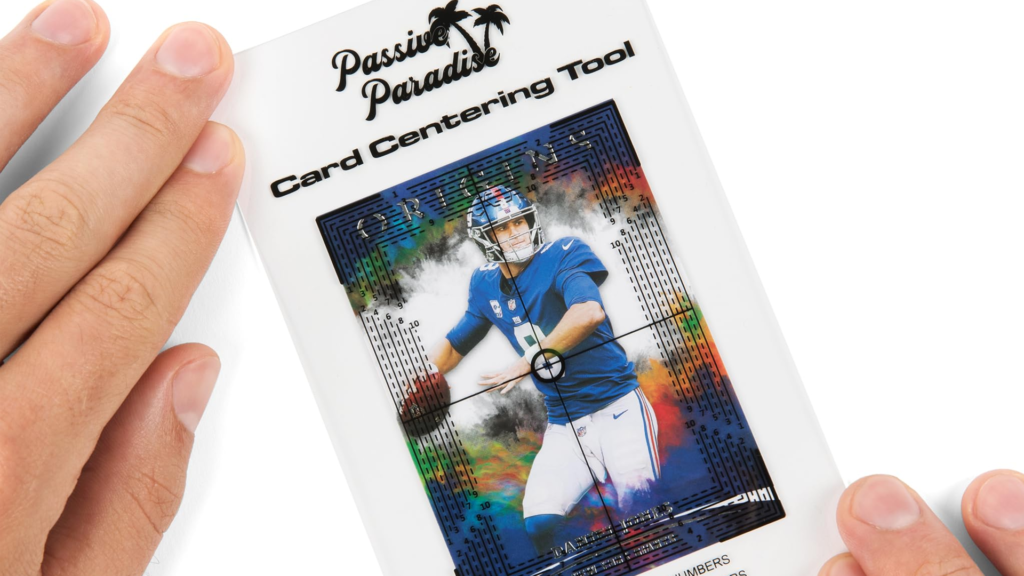
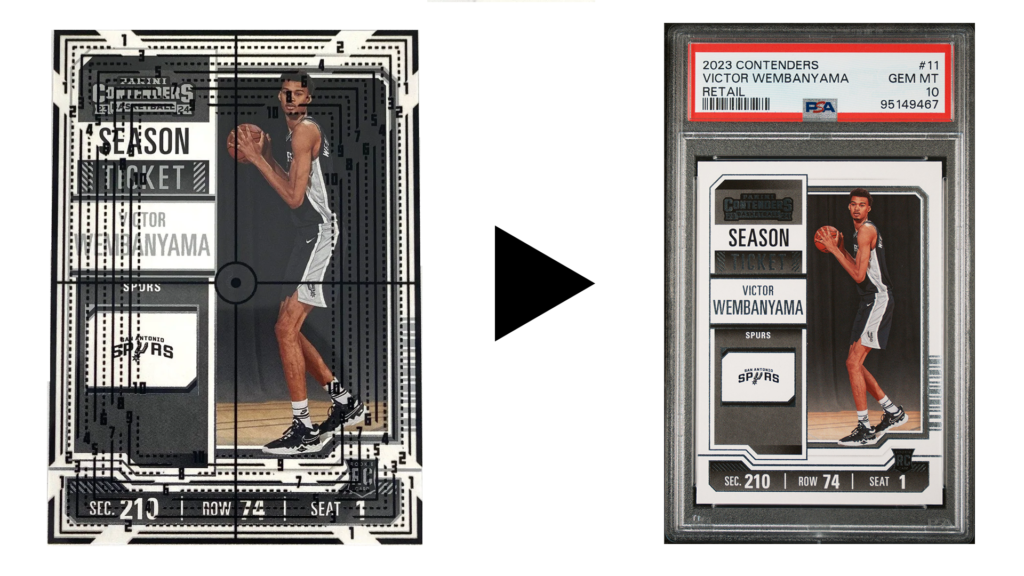
Never submit cards for grading without first checking centering using proper tools (centering templates, digital calipers, or online calculators). This single step prevents wasting grading fees on cards that can’t achieve target grades.
I use a Passive Paradise centering tool ($15) on every card before submission. Cards measuring worse than 59/41 don’t get submitted for PSA 10 attempts. Cards worse than 67/33 don’t get submitted at all unless they’re vintage or extremely valuable where even PSA 8 justifies grading costs.
Break-even calculations by centering:
Calculate expected value for each potential grade outcome:
Example: Modern rookie base card
- Raw value: $25
- PSA 10 value (55/45 centering): $150
- PSA 9 value (62/38 centering): $80
- PSA 8 value (68/32 centering): $45
- Grading cost (all-in): $30
If your card measures 55/45 centering with good corners/edges/surface:
- Expected grade: PSA 10
- Expected return: $150 – $30 = $120 profit
If your card measures 63/37 centering:
- Expected grade: PSA 9
- Expected return: $80 – $30 = $50 profit (marginal, but acceptable)
If your card measures 69/31 centering:
- Expected grade: PSA 8
- Expected return: $45 – $30 = $15 profit (probably not worth the hassle and 4-month wait)
When to submit anyway:
Vintage cards: Centering tolerances are looser, and even PSA 7-8 vintage cards have substantial value.
Ultra-rare cards: If the card is a 1/1, printing plate, or extremely rare parallel, even PSA 8 might be worth $500+ justifying submission despite poor centering.
Personal collection cornerstone: If it’s your favourite player’s key card and you want it slabbed for display regardless of grade, submit it.
Population play: If PSA 8 population is incredibly low (under 50 copies), even PSA 8 might command premiums.
I’ve submitted vintage cards with 72/28 centering knowing they’d grade PSA 7, but PSA 7 vintage still sells for significant premiums over raw cards making submission financially sensible.
The Centering Premium Explained
After submitting hundreds of cards and tracking thousands of dollars in grading returns, I’ve developed absolute conviction that centering is the single most important grading factor for modern cards seeking PSA 10 grades.
The fundamental reality is simple: corners can be perfect, edges can be flawless, surface can be pristine, but if centering measures 62/38, your card will never see PSA 10. That card is permanently capped at PSA 9 (or PSA 9 OC if centering is especially poor) regardless of other attributes.
This makes pre-grading centering checks the highest-ROI activity in card collecting. Spending 30 seconds measuring centering before submission prevents wasting $22-100 in grading fees on cards that can’t achieve target grades. Multiply those savings across 50 submissions annually, and proper centering pre-assessment saves $500-1,500 per year.
Key insights for collectors:
Centering is permanent. Unlike corners or surface that can degrade over time, centering is locked in at the factory. If it’s poor when the card is manufactured, it’s poor forever.
Centering drives value more than collectors expect. The gap between PSA 10 and PSA 9 purely from centering differences can be 50-300% of card value, far more than most collectors realize.
Current standards are strict. PSA’s shift from 60/40 to 55/45 for PSA 10 means cards that would have graded PSA 10 in 2020 now grade PSA 9. This tightening makes pre-grading assessment even more critical.
Visual inspection isn’t enough. Cards that “look centred” to naked eyes often measure 60/40 or worse under precise measurement. Use proper tools rather than eyeballing.
Perfect centering is genuinely rare. Only 20-40% of production achieves 55/45 or better, making well-centred cards legitimately scarce and valuable.
My personal submission strategy prioritises centering above all else. I’ll submit cards with microscopic corner touches or minor print lines if centering is excellent (53/47 or better). I won’t submit cards with perfect corners and surface if centering measures 61/39. This centering-first approach has dramatically improved my PSA 10 hit rate and overall grading ROI.
What’s been your experience with centering affecting grades? Have you had cards downgraded purely due to centering despite perfect corners and surface? Drop a comment below and share your centering war stories, we’ve all been burned by this unforgiving grading criterion.
Now if you’ll excuse me, I’ve got a stack of fresh rookies to measure before my next submission. Those centering tools aren’t optional, they’re essential. Happy collecting, and may all your borders be balanced!