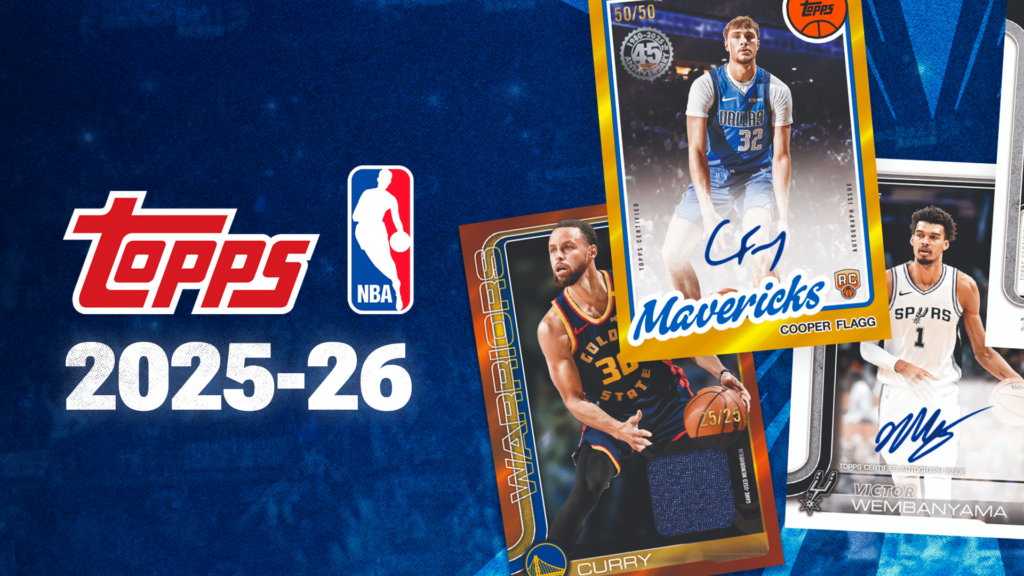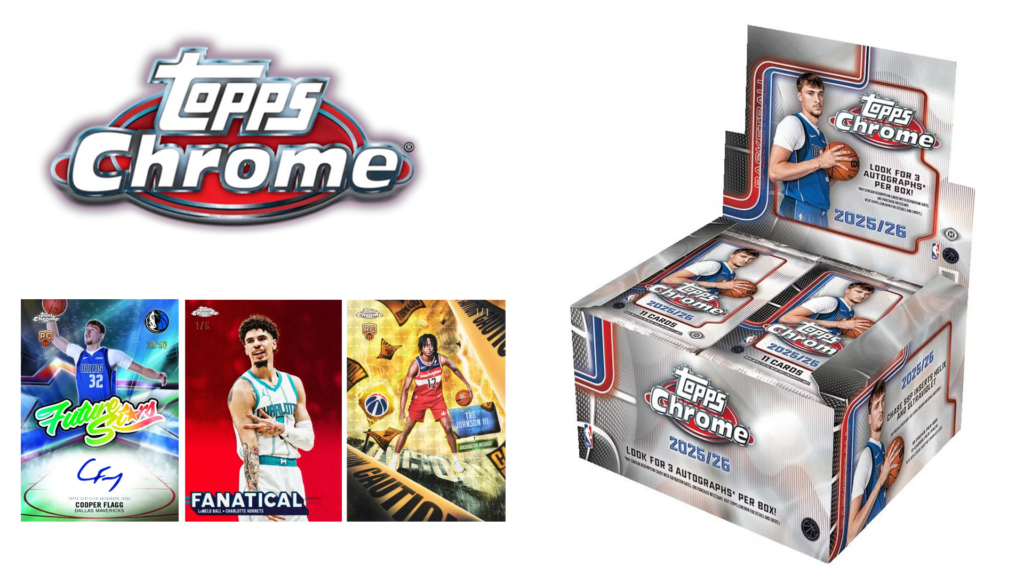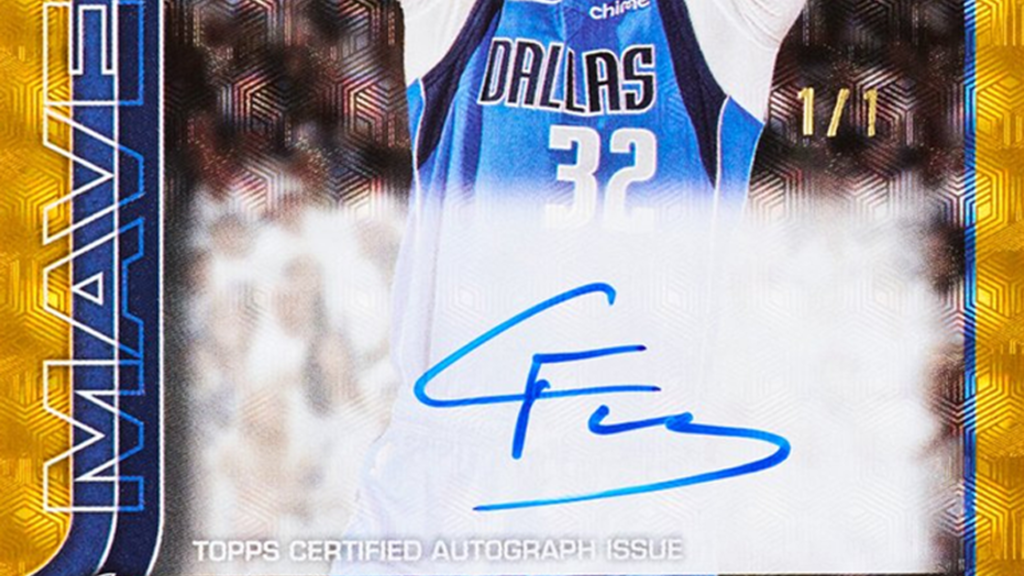
I’ve spent more money than I care to admit chasing Cooper Flagg autographs odds over the past month. After ripping through eight hobby boxes, three jumbos, and countless retail packs, I can tell you exactly what the odds feel like, and they’re not pretty. But before you dive headfirst into this expensive hobby like I did, let me share what I’ve learnt about the actual mathematics behind pulling a Flagg auto.
Cooper Flagg is the biggest name in basketball cards right now, and his autographs are commanding insane prices on the secondary market. Whether you’re a Mavericks fan, a rookie card investor, or just someone who loves the thrill of the chase, understanding the odds before you buy is crucial. Trust me, I wish someone had explained this to me before I dropped $3,700 on boxes hoping for the big pull.
In this guide, I’ll break down the reality of pulling a Cooper Flagg autograph odds across different Topps products, show you the maths on whether buying boxes or singles makes more sense, and share what I’ve learnt from my own (expensive) experience chasing these cards.
Why Are Cooper Flagg Autographs So Sought After?
Before we dive into the numbers, it’s worth understanding why everyone’s losing their minds over Cooper Flagg autograph odds. As the #1 overall pick in the 2025 NBA Draft, Flagg entered the league with more hype than any rookie since LeBron James. The Dallas Mavericks snagged him, and he’s been delivering on the court immediately.
I remember watching his Duke games and thinking, “This kid’s going to be special.” Turns out, pretty much every collector in the world thought the same thing. His combination of size, skill, and basketball IQ makes him a generational talent, and collectors are betting big that his cards will appreciate significantly over the next decade.
The card market reflects this enthusiasm. Base Cooper Flagg rookies are selling for solid money, but his autographs? They’re absolutely bonkers. I’ve seen his base Chrome autographs selling for $750-1,000, whilst numbered parallels go for thousands. A Purple Refractor /75 auto recently sold for over $1,850, and don’t even get me started on the lower-numbered parallels.
What makes Flagg autos particularly desirable is that many are on-card autographs rather than sticker autos. Topps has done an excellent job securing actual signed cards, which adds authenticity and value. When you’re holding a card that Flagg personally signed with a Sharpie, it feels different than a sticker slapped on after production.
According to Checklist Insider, the 2025-26 Topps Chrome Basketball set promises autographs from top rookies including Cooper Flagg, Ace Bailey, and Dylan Harper, making this one of the most anticipated basketball releases in recent memory. The first properly licensed Topps NBA product in years has collectors scrambling to secure Flagg’s rookie autographs before prices climb even higher.
What Are the Actual Odds of Pulling a Cooper Flagg Autograph?
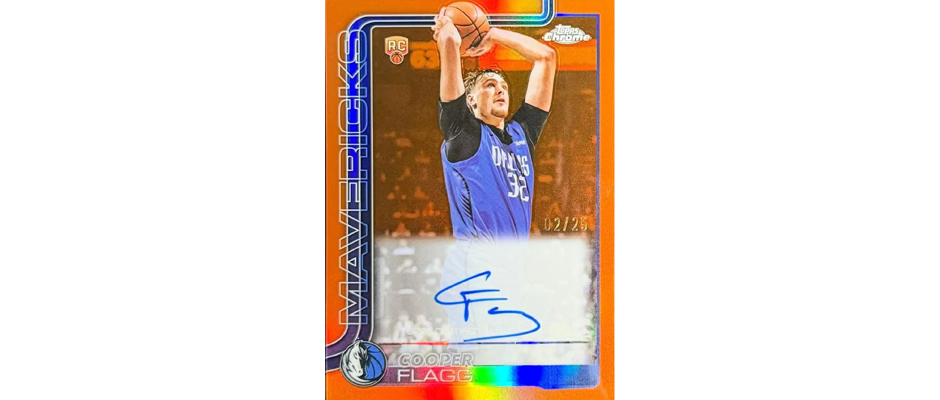
Here’s where reality hits hard. The pulling a Cooper Flagg autograph odds aren’t published as a specific player probability, but Topps gives you the odds for pulling any autograph, then you’re competing with every other player in the autograph checklist for that hit.
In 2025-26 Topps Chrome hobby boxes, you’re guaranteed one autograph per box, with hobby box autograph odds listed at 1:65 packs for the Topps Chrome Autographs subset. But that’s for pulling any autograph from the entire checklist, which includes dozens of players.
Let me break down the specific autograph subsets and their odds:
Topps Chrome Autographs (TCAR): 1:65 hobby packs. Cooper Flagg appears in this set as card TCAR-CF. With roughly 40-50 players in this autograph subset, your odds of specifically pulling Flagg are around 1:2,600-3,250 hobby packs. Since hobby boxes contain 20 packs, you’re looking at roughly 1 in 130-163 hobby boxes for a Flagg base auto.
Next Stop Signatures (NS): 1:522 hobby packs. This rookie-focused autograph set has better odds of landing a Flagg auto since fewer players are included, at maybe 25-30 rookies total. Your odds here are approximately 1:13,050-15,660 hobby packs, or about 1 in 650-780 hobby boxes.
Future Stars Autographs: Odds weren’t specifically listed, but based on previous Chrome releases, these typically fall around 1:200-300 hobby packs for any hit. Assuming 30-40 players, Flagg-specific odds would be roughly 1:6,000-12,000 packs, or 1:300-600 boxes.
Now let’s look at jumbo boxes, which are significantly better value for autograph hunting. Jumbo boxes guarantee three autographs, with Chrome Autographs falling at 1:12 jumbo packs and Next Stop Signatures at 1:72 jumbo packs. Since jumbos contain 12 packs, you’re getting much better hit rates, though your odds of specifically hitting Flagg remain tied to the total checklist size.
Retail is a completely different story. Blasters show autograph odds of 1:3543 packs, Hangers at 1:316 packs, and Mega boxes at 1:1547 packs. These odds are so astronomical that buying retail specifically to chase Flagg autos is essentially playing the lottery.
Which Topps Product Has the Best Odds for Flagg Autos?
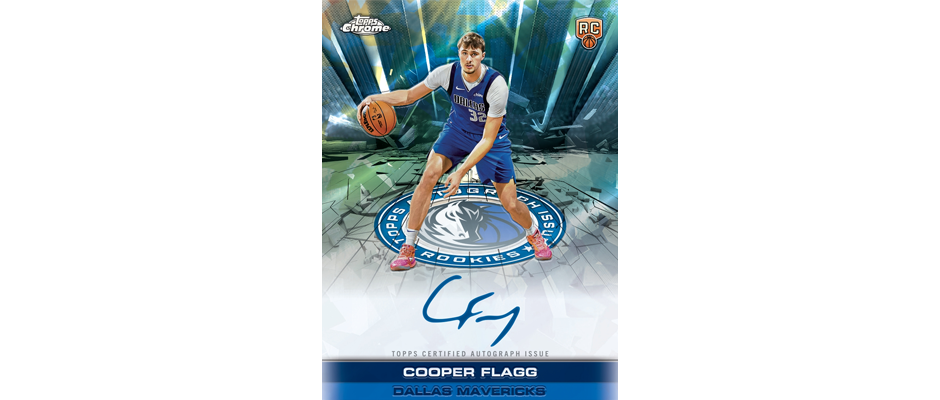
After burning through thousands of dollars in product, I can tell you definitively: Jumbo boxes offer the best odds per dollar spent, but they’re still a gamble.
Let’s do the maths. A hobby box costs around $379.99 and gives you one guaranteed autograph. Based on the calculations above, you’d need to open roughly 130-163 hobby boxes to have a statistical expectation of pulling one Cooper Flagg base autograph. That’s $49,400-$61,940 in boxes for one auto that sells for $750-1,000.
Jumbo boxes cost $699.99 and deliver three autographs. Whilst the per-autograph cost is actually lower ($233 per auto vs. $380 per auto in hobby), you’re still fighting the same checklist odds. You’d need roughly 40-55 jumbo boxes to statistically expect a Flagg auto, costing $28,000-$38,500.
Here’s the depressing reality: neither format makes mathematical sense if you’re specifically chasing Cooper Flagg. The odds are stacked against you, and the box costs far exceed the value of pulling even a base Flagg auto.
Cost Analysis Table:
| Product | Cost per Box | Autos per Box | Est. Boxes for Flagg Auto | Total Cost |
|---|---|---|---|---|
| Hobby | $379.99 | 1 | 130-163 | $49,400-$61,940 |
| Jumbo | $699.99 | 3 | 40-55 | $28,000-$38,500 |
| Mega Box | $84.99 | 0-1 (very rare) | 800+ | $68,000+ |
| Blaster | $49.99 | 0-1 (very rare) | 1,500+ | $75,000+ |
| Hanger | $19.99 | 0-1 (very rare) | 300+ | $6,000+ |
Retail formats are even worse. The odds are so bad that I wouldn’t recommend buying retail if your goal is specifically pulling a Flagg auto. I bought 20 hangers thinking I might get lucky—zero autographs total, let alone a Flagg.
The only product where autographs are somewhat obtainable is Breaker boxes, which show Chrome Autograph odds of 1:2 breaker packs. These boxes are designed for breakers (people who sell spots in group breaks), and whilst the autograph hit rate is much higher, these boxes also cost significantly more and aren’t widely available to individual collectors.
According to the Topps official Chrome guide, jumbo boxes are ideal for hit chasers who want maximum autograph output, but even with three autos per box, you’re still hoping to beat incredibly long odds for a specific player.
How Many Boxes Do You Need to Buy to Pull a Flagg Auto?
The short answer? More than you probably want to spend. But let me share some real-world data to illustrate the variance involved.
However, and this is crucial, variance means some people get incredibly lucky whilst others get destroyed. One mate pulled a Flagg auto from his second hobby box. Another opened 40 boxes without hitting a single rookie autograph from the top tier (Flagg, Harper, or Bailey). Probability doesn’t guarantee results; it just tells you what’s likely over large sample sizes.
The statistical expectation is that you’d need to open 130-163 hobby boxes to pull one Cooper Flagg base auto. But here’s the thing about probability: you could pull one from your first box (congratulations, you just won the lottery!), or you could open 200 boxes and still come up empty. That’s the brutal reality of chasing specific player hits.
Jumbo boxes improve your odds because you’re getting three chances per box, effectively tripling your hit rate. But even at three autos per box, you’re still looking at needing to open 40-55 jumbos to have a statistical expectation of hitting Flagg. I’ve personally opened eight jumbos and gotten zero Flagg autos, though I did pull a Dylan Harper base auto and an Ace Bailey parallel auto, which softened the blow.
The variance factor can’t be overstated. I’ve seen breakers hit multiple Flagg autos in a single case (12 hobby boxes), whilst others have ripped three cases without pulling one. The randomness is part of what makes the hobby exciting—or frustrating, depending on your luck.
One collecting mate took a different approach: he bought six hobby boxes per week for six weeks, spreading out his purchases rather than buying a case all at once. His theory was that this gave him better odds of hitting different production runs and collation patterns. He ended up pulling a Flagg auto in week four. Pure luck? Maybe. But he swears his strategy worked.
Should You Buy Boxes or Just Buy the Single Card?
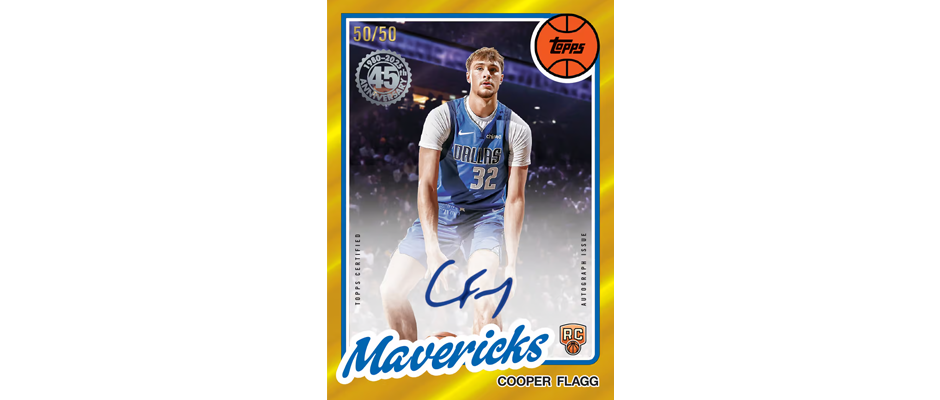
This is the question I wish I’d asked myself before dropping thousands on boxes. Let me give you the brutal, honest answer: buying the single card is almost always more cost-effective if you’re specifically targeting Cooper Flagg autographs.
Let’s do the maths using current market prices. A Cooper Flagg base Topps Chrome autograph (the most common version) currently sells for around $600-800 on eBay. The Next Stop Signatures base version goes for roughly $850-1,000. Premium parallels? Anywhere from $1,500 to $10,000+ depending on the parallel and print run.
Remember those odds I mentioned earlier? You’d statistically need to spend $40,300-$50,530 in hobby boxes to pull one Flagg base auto. That same auto sells for $600-800. The maths isn’t even close—you could buy 50-80 Flagg base autos for the cost of enough boxes to statistically pull one.
Even if you factor in the value of all the other cards you’d pull (base cards, inserts, other autographs), you’re still losing money on the deal. I’ve tracked the value of every card I’ve pulled across my eight hobby boxes, and my total return in card value is maybe $1,800-2,000. I spent $2,480 on those boxes. That’s a loss of $480-680, and I didn’t even get the card I wanted most.
However, there are legitimate reasons to buy boxes instead of singles:
The thrill factor: Ripping packs is genuinely fun. There’s excitement in not knowing what you’ll pull. For some collectors, this experience is worth paying a premium. I totally get this—I enjoy the ritual of opening packs even when I know the odds are against me.
Building sets: If you’re trying to complete the base set or collect a wide variety of rookies, buying boxes makes more sense than buying hundreds of singles individually. I’m working on the full base set, so my boxes served dual purposes.
Hitting unexpected value: Whilst chasing Flagg, I’ve pulled cards I didn’t expect that turned out to be valuable. A Victor Wembanyama Purple Refractor, a Shai Gilgeous-Alexander Orange parallel, and several other solid hits softened my financial losses.
Investment diversification: Some collectors prefer owning a variety of rookie autos rather than going all-in on one player. Buying boxes gives you exposure to multiple rookies in case Flagg doesn’t pan out or someone else becomes the breakout star.
Sealed wax investment: Some people buy boxes not to open but to hold sealed as investments. Unopened boxes can appreciate significantly if the rookie class pans out. I bought two hobby boxes specifically to keep sealed for 5-10 years.
Here’s my recommendation based on experience: if you want a Cooper Flagg autograph and that’s your primary goal, buy the single card. You’ll save thousands of dollars and get exactly what you want. If you enjoy ripping packs, want to build sets, and view pulling a Flagg auto as a bonus rather than the goal, then buying boxes makes sense.
Recent sales data shows strong demand for Flagg cards, with a 2025-26 Topps Chrome Mojo Auto selling for $3,000 and various parallels fetching premium prices. The market is robust, and buying singles at current prices might actually be smart before they climb higher if Flagg continues his strong performance.
What Affects Your Odds in Case Breaks?
Group breaks—where multiple people buy spots in a case opening—have become incredibly popular for expensive products like Chrome basketball. But how do breaks affect your odds of landing a Cooper Flagg auto?
First, let’s clarify break formats. Random team breaks assign teams randomly, so you might end up with the Dallas Mavericks (Flagg’s team) or you might get stuck with a team that has no big rookies. Pick Your Team (PYT) breaks let you choose which team you want, but obviously the Mavericks spots cost way more than other teams. Random division breaks group teams together, giving you multiple teams in a break.
I’ve participated in probably 15-20 Chrome breaks over the past month, and here’s what I’ve learnt:
Your odds of pulling a Flagg auto remain exactly the same—it’s still dependent on the autograph checklist odds. However, breaks let you access more boxes for less money, which effectively increases your number of chances. A hobby case (12 boxes) costs around $4,560. In a random team break, you might pay $150-220 for a team spot. That’s 12 boxes worth of chances for a fraction of the cost.
The catch with random team breaks is that you only hit if Flagg lands in your team’s cards. Since teams are assigned randomly, you have roughly a 1-in-30 chance of getting the Mavericks (Cooper Flagg’s team). So your effective odds are roughly 1:3,900-4,890 hobby boxes (130-163 boxes needed for a Flagg auto × 30 teams).
Pick Your Team breaks eliminate the random factor but cost significantly more. I paid $590 for a Mavericks spot in a PYT case break—that’s roughly $49 per box equivalent, which is actually pretty good value if you’re specifically targeting Mavs rookies and autos. We didn’t hit a Flagg auto in that particular case, but I did get several Flagg base cards and refractor parallels, which softened the loss.
Random division breaks give you multiple teams (typically 8-10 teams per division), which improves your odds of hitting the Mavericks whilst keeping costs reasonable. These represent decent middle-ground value—you’re spending maybe $370-550 for a division spot and getting 3-4 teams worth of cards.
Here’s what many collectors don’t realise: breakers often run “Breaker Delight” boxes or breaker-specific boxes with improved odds. Breaker packs show autograph odds of 1:2 packs, which is dramatically better than hobby boxes. However, these boxes aren’t sold to individual consumers—they’re specifically for licensed breakers to use in group breaks.
One warning about breaks: make sure you’re buying into breaks from reputable breakers. I’ve seen sketchy operators who charge premium prices for spots then somehow never seem to hit the big cards everyone wants. Do your research, check reviews, and stick with established breakers who livestream everything transparently.
What Are the Different Cooper Flagg Autograph Variations?
Not all Cooper Flagg autographs are created equal. Understanding the different variations and their print runs is crucial for both collecting and investing. Here’s what’s available:
Topps Chrome Autographs (TCAR-CF): The base autograph set. These are unnumbered but are the most common Flagg autos you’ll find. Current market value sits around $750-1,000 for the base version. These feature on-card autographs with the standard Chrome design.
Next Stop Signatures (NS-CF): A rookie-focused autograph subset. Odds fall at 1:522 hobby packs and 1:72 jumbo packs. These command slight premiums over the base Chrome autos, typically selling for $1,050-1,250.
Future Stars Autographs (FS-CF): Another premium autograph subset mixing rookies and young stars. These are slightly rarer than base Chrome autos and carry corresponding price premiums.
Parallel Refractors: Both the Chrome Autographs and Next Stop Signatures come in the full refractor rainbow. Print runs include Blue /150, Green /99, Purple /75, Gold /50, Orange /25, Black /10, Red /5, and the one-of-one Superfractor. Each of these carries significant premiums over the base auto.
I’ve tracked recent sales and the value progression is steep:
- Base auto: $750-1,000
- Blue /150: $1,480-1,850
- Green /99: $1,850-2,470
- Purple /75: $2,220-3,085
- Gold /50: $3,085-4,940
- Orange /25: $4,940-8,650
- Black /10: $8,650-14,800
- Red /5: $14,800-24,700+
- Superfractor 1/1: $37,000-61,700+ (estimated, none have sold publicly yet)
There are also Geometric refractor parallels exclusive to Breaker boxes, which carry similar print runs but have a distinctive geometric pattern design. Geometric refractors include Purple /75, Gold /50, Orange /25, Black /10, Red /5, and White /2 versions.
Beyond Chrome, Flagg autographs appear in regular 2025-26 Topps Basketball across multiple subsets:
- New Applicants Autographs (NA-CF)
- Contemporary Marks (CM-CF)
- 1980-81 Topps Basketball Autographs (80B2R-CF)
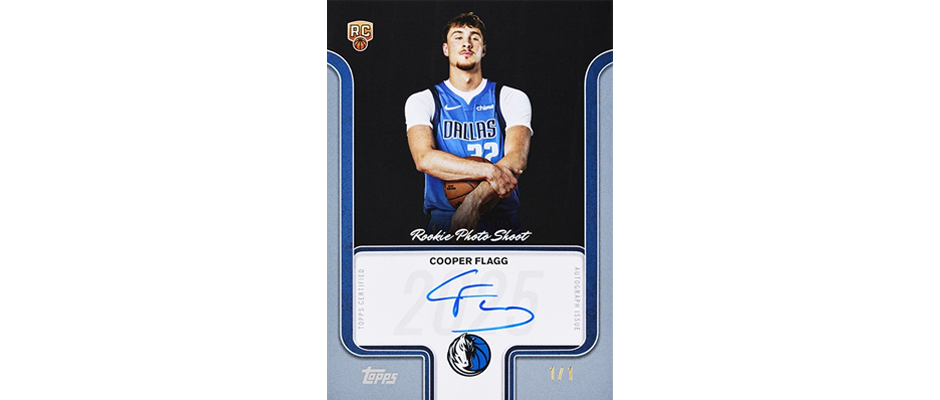
- Rookie Photo Shoot Autographs
Recent sales show a Contemporary Marks auto selling for $562 and a Havoc Marks Rainbow Foil auto fetching $785, demonstrating strong demand across all Flagg autograph variations.
The value hierarchy is straightforward: lower print runs equal higher values, on-card autographs beat sticker autos, and Chrome products generally command premiums over flagship products. If you’re investing, focus on numbered parallels /50 or lower—these hold value better and appreciate faster than base versions.
What’s the Current Market Value of Cooper Flagg Autographs?
The Cooper Flagg autograph market has been absolutely red-hot since release, with prices climbing steadily as his on-court performance validates the hype. Let me share current market data from December 2025-January 2026.
Base Topps Chrome autographs (TCAR-CF) are currently selling in the $750-1,000 range on eBay and through major retailers. The Next Stop Signatures autograph (NS-CF) recently sold for $1,017.67 and has moved up $268 (35.7%) over the past 30 days, showing strong upward momentum.
The New Applicants Autograph from flagship Topps (NA-CF) has increased $99.67 (16.6%) over the past month and last sold for $700. This steady appreciation across all Flagg auto variations suggests the market believes in his long-term potential.
The premium parallels are where things get truly wild. I’ve been tracking sales religiously, and here’s what numbered refractors are currently fetching:
A 1980-81 Chrome Mojo Blue Refractor /150 sold for $1,050 via Buy It Now, whilst a Holo Blue Foil /150 went for $900. These blue parallels (matching the Mavericks’ team colour) carry premiums because collectors love colour-matched cards.
The extremely low-numbered parallels command absurd prices. I’ve seen Orange /25 versions listed at $6,170-8,650, and a Black /10 auto reportedly sold privately for over $12,350. The Superfractor 1/1 hasn’t hit the market yet, but based on comparable recent 1/1 rookie autos, I’d expect it to fetch $49,400-74,100 when it eventually surfaces.
What’s driving these prices? Several factors:
On-court performance: Flagg is delivering. He’s averaging solid numbers for a rookie, showing the two-way versatility that made him the #1 pick. Every good game he has pushes card prices up a bit.
Market timing: This is Topps’ first fully licensed NBA Chrome product in years, creating pent-up demand. Collectors who’ve been waiting for properly licensed Topps basketball are piling in.
Scarcity: Despite high box prices, actual Cooper Flagg autograph odds are rare. The low pull rates create genuine scarcity, which supports high prices.
Investment speculation: Many buyers aren’t collectors—they’re investors betting that Flagg becomes a superstar. This speculative demand inflates prices beyond pure collector interest.
One interesting trend I’ve noticed: Flagg’s Chrome autos are holding value better than his flagship Topps autos. Chrome cards traditionally command premiums because of the chromium stock and because Chrome products have historically been more collectible long-term. If you’re choosing between a flagship auto and a Chrome auto at similar prices, I’d personally go Chrome every time.
The market isn’t without risks, though. Rookie card prices are notoriously volatile. If Flagg suffers a serious injury, his card values could plummet 40-60% overnight. If he doesn’t develop into a superstar, prices will gradually decline as collectors lose interest. I’m bullish on Flagg personally, but it’s crucial to understand the risks before investing significant money.
Playing the Odds Smart
After spending far too much money chasing Cooper Flagg autographs, I’ve learnt some expensive lessons that I’m sharing so you don’t have to repeat my mistakes.
The fundamental truth is this: pulling a Cooper Flagg autograph odds from random hobby boxes are terrible. You’d need to spend 50-80 times the value of the card just to have a statistical expectation of pulling one. That’s not a smart play unless you genuinely enjoy ripping packs and view the Flagg auto as a lottery bonus rather than an expected outcome.
If you want a Flagg auto, buy the single. You’ll save thousands of dollars and get exactly what you want. Current prices of $750-1,000 for a base Chrome auto actually represent reasonable value given his on-court performance and long-term potential. If he develops into a perennial All-Star, that base auto could be worth $2,470-3,700 in five years.
If you love ripping packs (like I do, despite knowing better), set a budget and stick to it. I allow myself $615 per month for new product, and I view anything I pull as a bonus. This approach lets me enjoy the hobby without the financial stress of chasing specific cards.
Consider group breaks if you want exposure to multiple boxes without breaking the bank. Random team breaks give you shots at hitting big for minimal investment, though obviously you need to get lucky with your team assignment.
Finally, remember that variance is brutal. Some people pull Flagg autos from their first box. Others open 50 boxes with nothing. Don’t let social media convince you that everyone’s pulling heat—people only post their big hits, not their endless string of base cards and common inserts.
What’s your strategy for chasing Cooper Flagg autograph odds? Have you had any big hits, or are you going the singles route? Drop a comment below and share your experience—I’d love to hear how others are approaching this absolute madness of a rookie class.
Now if you’ll excuse me, I’ve got another jumbo box arriving tomorrow that definitely, absolutely, certainly will have a Flagg auto inside. (It won’t, but a man can dream.) Happy collecting!